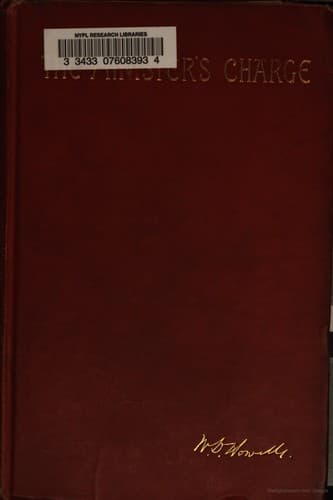
The Minister's Charge; Or, The Apprenticeship of Lemuel BarkerHowells, William Dean
General
The Minister's Charge; Or, The Apprenticeship of Lemuel Barker
Howells, William Dean
Boston (Mass.) -- Fiction; Clergy -- Fiction; Poets -- Fiction
Some of the ladies at the St. Albans had tried to argue with Lemuel
about his not taking the fees he refused, and he knew that they talked
him over. One day, when he was showing a room to a transient, he heard
one of them say to another in the next apartment, “Well, I did hate
to offer it to him, just as if he was a common servant;” and the other
said, “Well, I don't see what he can expect if he puts himself in the
place of a servant.” And then they debated together whether his quality
of clerk was sufficient to redeem him from the reproach of servitude;
they did not call his running the elevator anything, because a clerk
might do that in a casual way without loss of dignity; they alleged
other cases of the kind.
His inner life became a turmoil of suspicions, that attached themselves
to every word spoken to him by those who must think themselves above
him. He could see now how far behind in everything Willoughby Pastures
was, and how the summer folks could not help despising the people that
took them to board, and waited on them like servants in cities. He
esteemed the boarders at the St. Albans in the degree that he thought
them enlightened enough to contemn him for his station; and he had his
own ideas of how such a person as Mr. Evans really felt toward him. He
felt toward him and was interested in his reading as a person might feel
toward and be interested in the attainments of some anomalous animal, a
learned pig, or something of that kind.
He could look back, now, on his life at Miss Vane's, and see that he was
treated as a servant there,--a petted servant, but still a servant,--and
that was what made that girl behave so to him; he always thought of
Sibyl as that girl.
He would have thrown up his place at once, though he knew of nothing
else he could do; he would have risked starving rather than keep it;
but he felt that it was of no use; that the stain of servitude was
indelible; that if he were lifted to the highest station, it would not
redeem him in Miss Carver's eyes. All this time he had scarcely more
than spoken with her, to return her good mornings at the dining-room
door, or to exchange greetings with her on the stairs, or to receive
some charge from her in going out, or to answer some question of hers
in coming in, as to whether any of the pupils who had lessons of her
had been there in her absence. He made these interviews as brief as
possible; he was as stiff and cold as she.
Public-domain text, read in full here on John Shaqi.
Reviews
Reviews
No reviews yet
Be the first to share your thoughts on this work.
Elsewhere in the archive
Join the Discussion
Join the discussion
Sign in to leave a comment or review.
Sign InorCreate an account