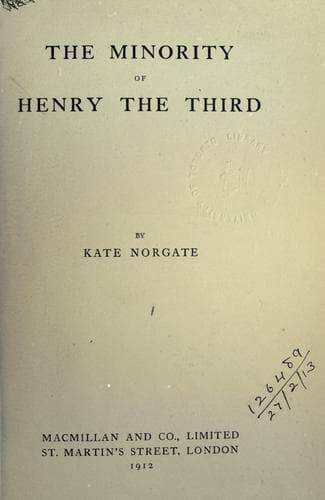
Great Britain -- History -- Henry III, 1216-1272; Henry III, King of England, 1207-1272
of an officer of the Crown;[54] the King’s undertaking not to punish
or prosecute any man in any way except by the lawful judgement of his
peers and according to the law of the land,[55] and neither to sell,
deny, or delay, right and justice to any,[56] not to exact unfair
reliefs from escheated baronies,[57] not to summon men to the Forest
Courts from districts outside the Forest jurisdiction and on pleas
unconnected with it;[58] the clause securing the custody of vacant
abbeys to those who were entitled to it as founders,[59] and that
which forbade arrest or imprisonment for manslaughter on the appeal of
any woman other than the wife of the slain man[60]--were all renewed,
as were also the promises given by John that the Forests made in his
reign should be disafforested and the river enclosures made during the
same period destroyed.[61] Henry pledged himself, as John had done, to
give immediate redress to any Welshmen whom John had dispossessed of
their lands without lawful judgement of their peers.[62] The article
concerning the ancient liberties and customs of London and other towns
was renewed, with the insertion of a special mention of the Cinque
Ports.[63] That which forbade the King’s constables to seize any man’s
corn or cattle without immediate payment, except by the owner’s leave,
was modified; if the owner belonged to the township in which the
castle stood, payment might be deferred for three weeks.[64] Another
article of the Great Charter had forbidden all sheriffs and other
officers of the Crown to use any freeman’s horses or carts without
the owner’s consent; they were now permitted to do so on payment of
a sum “anciently fixed”--tenpence a day for a cart with two horses,
fourteenpence a day for a cart with three horses.[65] The general rule
laid down in 1215 that “all merchants should come and go and dwell and
trade in England, in time of peace, without the imposition of arbitrary
customs” (“maltotes”), was limited by the insertion of a proviso,
“unless they have been publicly forbidden.”[66] Nineteen articles were
entirely omitted. There was no renewal of the articles forbidding
the exaction of interest, during the minority of a debtor’s heir, on
money borrowed from the Jews or others; nor of the royal promises
to institute an inquiry into the abuses of the Forest law and of the
Crown’s rights over escheated baronies, to remove from all offices in
England certain of John’s foreign adherents, to make restitution to
persons illegally disseised under John, to remit fines made illegally
with him, to reinstate Welshmen illegally disseised under Henry II.
and Richard, and to appoint no justiciars, constables, sheriffs, or
bailiffs, save those who knew the law of the realm and were minded
to observe it well.[67] The articles declaring that the ferms of
the shires, wapentakes, and hundreds should be reduced to their old
figures, without increment (except on royal manors); sanctioning the
Public-domain text, read in full here on John Shaqi.
Reviews
Reviews
No reviews yet
Be the first to share your thoughts on this work.
Join the Discussion
Join the discussion
Sign in to leave a comment or review.
Sign InorCreate an account