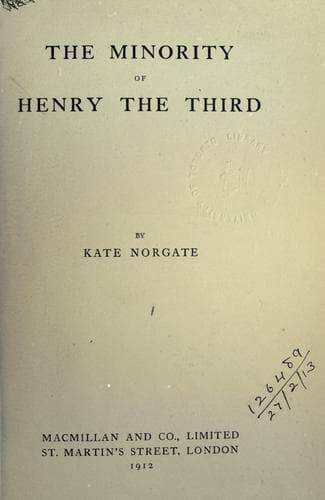
Great Britain -- History -- Henry III, 1216-1272; Henry III, King of England, 1207-1272
Pandulf and Peter des Roches, meanwhile, had enlisted the services of
the Dean of Poitiers, who visited England in August, to negotiate with
Hugh of La Marche for a truce.[670] A carucage “for our great needs,
most urgent debts, and the preservation of our land of Poitou” had been
agreed upon in a council at Oxford on 9th August.[671] Negotiations
with the communes of La Rochelle and Bordeaux for a loan “for the safe
keeping of Poitou and Gascony” were begun in September.[672] These
two towns, with Niort and S. Jean d’Angély, had now resolved upon
sending representatives to England to lay their complaints before
the Council; the Preceptor of the Temple, Gerard Brochard, at their
request undertook to accompany these envoys, and begged the Council to
give him and them an audience in London in the week after Michaelmas,
“to hear the proposals of the count of La Marche, and of others, on
all sides.” Gerard, it is clear, was in the confidence of all parties,
and he declared positively that if the Council would listen to him,
the damsel Joan would be restored to them in honour and freedom;
“she would have been delivered to me,” he said, “if I would have
stood surety that the King would do to the count what he ought.”[673]
Probably Gerard received in London, and thence transmitted to Hugh, a
formal assurance that Henry would “do what he ought”--in other words,
surrender his mother’s dowry. At the same time the Pope took up the
matter; and a letter from him, on 20th September, threatening that
if Hugh did not within fifteen days after its receipt deliver Joan,
together with the city of Saintes and the Isle of Oléron (which had
been pledged to him by John as security for her dowry) to Henry’s
appointed representatives, he should be excommunicated and his lands
placed under interdict,[674] was followed by Hugh’s submission, so far
as the surrender of Joan herself was concerned. In obedience to an
order from England issued on 6th October that he should either himself
bring Joan to England, or deliver her at La Rochelle to certain persons
appointed to receive her there,[675] he set out with the child; but he
fell sick at Oléron, where the Dean of Poitiers and the new seneschal
of Aquitaine, Philip of Ulecote, had been ordered to meet him. The
Dean waited for the seneschal in vain, and at last learned that he was
dead.[676] At the beginning of November Hugh, being too ill to proceed,
delivered Joan to the commissioners--the Dean and two other envoys--who
escorted her to La Rochelle.[677] The term fixed for her marriage was
past, but at its expiration, on 13th October, Henry and Alexander had
met again at York,[678] and Alexander had evidently consented to wait
for her with patience; he waited in fact till the following Midsummer.
Her stepfather, when he gave her up to Henry’s commissioners, assured
them of his intention to go and perform his homage for La Marche and
Angoulême as soon as his health should permit him.[679] Thus for a few
Public-domain text, read in full here on John Shaqi.
Reviews
Reviews
No reviews yet
Be the first to share your thoughts on this work.
Elsewhere in the archive
Join the Discussion
Join the discussion
Sign in to leave a comment or review.
Sign InorCreate an account