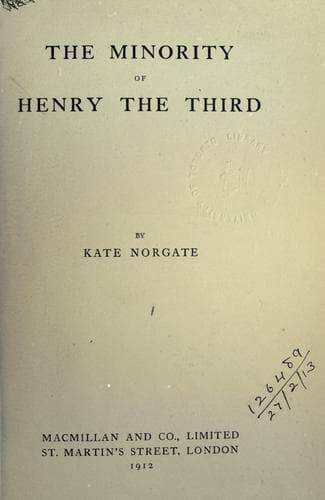
Great Britain -- History -- Henry III, 1216-1272; Henry III, King of England, 1207-1272
[592] _Roy. Lett._, vol. i. p. 98.
[593] _Close Rolls_, vol. i. p. 400 b.
[594] _Roy. Lett._, vol. i. p. 99.
[595] _Ib._ pp. 128, 129.
[596] _Pat. Rolls_, vol. i. pp. 263–265.
[597] _Roy. Lett._, vol. i. pp. 16, 17.
[598] There can be no doubt that this is the “forma pacis” which
Pandulf asks Ralf de Neville to send him in May 1219: _ib._ p. 117 (for
date see above, p. 113).
[599] _Pat. Rolls_, vol. i. p. 197.
[600] _Foedera_, I. i. p. 157. The letter is dateless, but there can
be no doubt about its reference. It cannot refer to the treaty made
between the two kings at York in June 1220, because on that occasion
Peter, as well as Pandulf, was present in person; _Pat. Rolls_, vol. i.
p. 235.
[601] This was explicitly stated in the charge against Hubert de Burgh
in 1239, as reported in his _Responsiones_, M. Paris, _Chron. Maj._,
vol. vi. pp. 70–71. A promise that one of William’s daughters should
be married to one of John’s sons is also mentioned by Gervase of
Canterbury (vol. i. p. 103) as included in the treaty of Norham. The
text of that treaty in _Foedera_, I. i. p. 103, rests on no authority
beyond that of Rymer.
[602] Both Margaret and her sister were born before the end of 1195; R.
Howden, vol. iii. pp. 299, 308.
[603] “Primae conventiones.”
[604] _Responsiones_, p. 71.
[605] _Roy. Lett._, vol. i. pp. 59, 60.
[606] _Close Rolls_, vol. i. p. 434.
[607] _Roy. Lett._, vol. i. pp. 58, 59, 76, 77; _Foedera_, I. i. p. 157.
[608] _Pat. Rolls_, vol. i. pp. 260, 261.
[609] _Close Rolls_, vol. i. pp. 418, 418 b. Llywelyn’s version, as
given in a letter from him to Pandulf, _Roy. Lett._, vol. i. pp. 122,
123, was very different.
[610] _Roy. Lett._, vol. i. p. 143.
[611] _Foedera_, I. i. p. 159.
[612] W. Cov., vol. ii. p. 244.
[613] “Eodemque anno ... devotus Deo rex Henricus III fecit inchoari
fabricam novae capellae B. Virginis apud Westmonasterium, eodem rege
existente fundatore et patrono, et primum lapidem operis in fundamento
in bonum auspicium disponente, videlicet sabbato sancto Pentecostes.”
M. Paris, _Hist. Angl._ a. 1220, vol. ii. p. 242. Cf. R. Coggeshall, p.
188, and _Ann. Berm._, a. 1220.
Public-domain text, read in full here on John Shaqi.
Reviews
Reviews
No reviews yet
Be the first to share your thoughts on this work.
Elsewhere in the archive
Join the Discussion
Join the discussion
Sign in to leave a comment or review.
Sign InorCreate an account