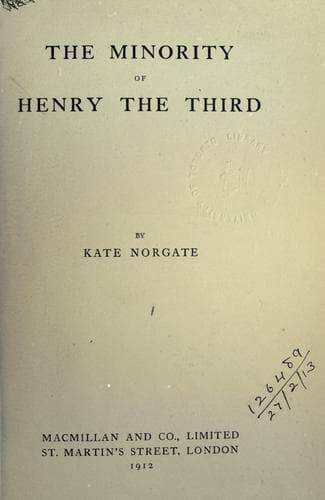
Great Britain -- History -- Henry III, 1216-1272; Henry III, King of England, 1207-1272
The King and the Justiciar were recalled to London, partly, no doubt,
by the weighty news from France, and partly by the necessity of
receiving the titular King of Jerusalem, John of Brienne, who was
travelling through western Europe to collect forces and funds for the
recovery of his kingdom from the Turks. An “aid for the Holy Land,” of
three marks from every earl, one mark from every baron, twelve pence
from every knight, and one penny from every free tiller of the soil
and every free man who had no land, but had chattels to the value
of half a mark, had been agreed upon by the great Council of the
realm in 1222,[888] but had never been collected.[889] No Christian
sovereign, however, could evade the duty of giving at least a personal
welcome, even if he gave nothing more, to the successor of Godfrey
of Bouillon. John seems to have crossed from France to England at
the end of August.[890] On 1st or 2nd September the English King and
Primate received him “solemnly and with great honours” at Canterbury,
and escorted him to London.[891] His visit was a brief one, and the
hospitality which he received in England was probably amply requited by
the gift of four large sapphires--“than which we never saw finer,” says
Matthew Paris--which he, “out of his innate munificence,” on his way
back offered at the shrine of S. Thomas at Canterbury.[892]
As soon as their royal guest was gone, King and Justiciar hurried back
to the Welsh border. The English host under the Marshal and the Earl
of Salisbury had apparently set out with the intention of joining the
Marshal’s other forces in Pembrokeshire. It was caught by Gruffudd in
one of the intricate passes of the Welsh hills, and narrowly escaped
destruction,[893] but it seems to have cut its way through; and the
Marshal set to work to fortify “the lands which he occupied,”--that
is, doubtless, the districts of Caermarthen and Gower--by founding new
castles and repairing old ones.[894] Llywelyn’s next diversion was to
lay siege, early in September,[895] to Reginald de Breuse’s castle of
Builth, with such a numerous force that Reginald immediately applied
to the Crown for help.[896] On 12th September the host was summoned to
meet the King “with all haste” at Gloucester,[897] and march with him
to the relief of Builth. The expedition probably set out from Hereford
on the 19th or 20th. Its mere approach sufficed to raise the siege; on
the 23rd King and Justiciar were back at Hereford.[898]
Public-domain text, read in full here on John Shaqi.
Reviews
Reviews
No reviews yet
Be the first to share your thoughts on this work.
Elsewhere in the archive
Join the Discussion
Join the discussion
Sign in to leave a comment or review.
Sign InorCreate an account