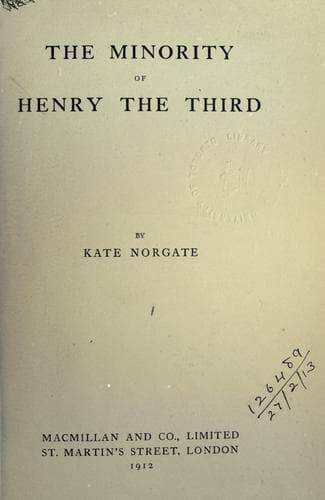
Great Britain -- History -- Henry III, 1216-1272; Henry III, King of England, 1207-1272
that his conduct as a bishop did not err on the side of neglect or
laxity in matters of order and discipline. His material benefactions
to his church, and the diligence and ability with which he managed the
temporal concerns of his see, were indisputable; and there is nothing
to indicate that he failed in any of his episcopal duties. But Peter
was ambitious of exercising his talents in a wider field than that of
diocesan administration; and his talents were great enough to justify
his ambition. After his death Matthew Paris declared that “the whole
council of the realm of England, royal as well as ecclesiastical, had
suffered an irreparable loss” in losing him.[914] Under Pandulf he and
Hubert had worked together almost as equals; but before the end of the
year 1221 Peter found himself Hubert’s subordinate, and found, too,
that his chance of regaining at a future time his former influence in
matters of state was diminishing day by day; for though the King’s
ex-tutor retained his seat in the Council, the King had virtually
become Hubert’s pupil instead of his.
There was only one possible means of altering this state of things:
to put Henry into possession, if not of full regal powers, at least
of some voice in the government of his own realm, something like a
decisive vote in his own Council. If this were done, the Justiciar’s
supremacy would become dependent on his personal influence over the
King’s mind; and if it were done quickly, while that mind was still
young and tender and had not yet had time to take the mould of Hubert’s
political teaching, Peter might fairly hope to be more than a match for
Hubert. A suggestion that something of this kind should be done seems
to have been conveyed to the Pope from England at some time before the
middle of April, 1223,[915] and to have been either coupled with, or
accompanied or followed by, a request that the Pope would issue some
instructions concerning the royal castles. When the result of these
two suggestions appeared, the onus of responsibility for it fell upon
Hubert; Hubert, however, in later days declared that the Pope’s action
in the matter had been instigated by the Bishop of Winchester, against
the interests of Hubert himself. Meanwhile a number of the magnates
had for some time past been murmuring among themselves against the
Justiciar, resenting his haughty bearing and his (in their opinion)
high-handed judicial decisions in cases where they were concerned,
and “saying to one another that he stirred up the King’s mind against
them, and likewise that he ruled the kingdom by unjust laws.”[916] A
step which he took at the beginning of 1223 aggravated their resentment
and their distrust. On 30th January orders were issued in the King’s
name for the sheriffs to inquire in full county court, by a sworn jury
of twelve knights, what customs and liberties King John had in the
shires before the war between him and the barons began; to proclaim
Public-domain text, read in full here on John Shaqi.
Reviews
Reviews
No reviews yet
Be the first to share your thoughts on this work.
Elsewhere in the archive
Join the Discussion
Join the discussion
Sign in to leave a comment or review.
Sign InorCreate an account