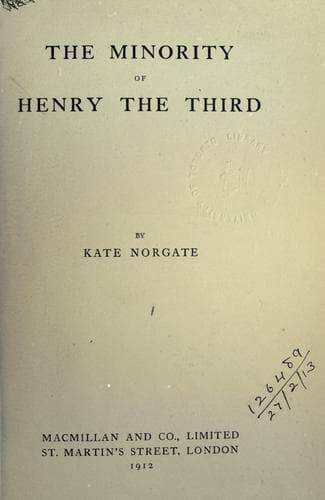
Great Britain -- History -- Henry III, 1216-1272; Henry III, King of England, 1207-1272
in order that, as the absolution of an excommunicate person was an
extremely humiliating ceremony for the penitent, it might serve as a
salutary warning to other possible rebels. Accordingly, when Falkes had
sworn to submit himself to this humiliation on 25th August in London,
a safe-conduct was given him, on 19th August, to go thither for the
twofold purpose of receiving absolution and paying into the treasury,
as compensation for the damage and losses incurred by the King in the
siege of Bedford, the money which he had stored at Westminster.[1113]
On the appointed day {25 Aug.}, in presence of a great concourse of
people, the Archbishop had him stripped according to the rule of the
Church and then gave him absolution.[1114] He then executed a deed
whereby he surrendered to the Crown all his possessions of every kind,
and consented to fall under excommunication again if his constables at
Plympton and Stoke Courcy failed to give up those two castles within a
fortnight.[1115]
A woman struck the next blow at the fallen man. Margaret his wife came
before the King and the Archbishop and declared that she had never
consented to her marriage with him, but had been taken by force in time
of war and wedded to him against her will, wherefore she prayed that
the marriage might be annulled. A day was set for the Archbishop to
pronounce, after due consideration, his judgement on the matter.[1116]
Margaret’s story of the marriage may very likely have been true; but
her protest was made too late to deserve a hearing. Even in 1215 the
widow of Baldwin de Rivers was no mere child, for she was already a
mother. If the disturbed state of public affairs and the absence of
the Primate prevented her seeking legal redress during the next two
years, she could certainly have brought her claim before Stephen at any
moment after his return in the spring of 1218. Instead of doing so,
she waited till the man whose prosperous fortunes she had shared for
nine years, and by whom she had at least one child,[1117] was brought
down to the dust, and then she, too, sought to be rid of him. Such an
abuse of the laws of marriage as she petitioned for was not likely to
be sanctioned by Stephen de Langton, however sternly he might, for the
public weal, deem it necessary to deal with her husband. His judgement
on her petition is not recorded; but there are clear indications that
it was given against her.[1118]
Public-domain text, read in full here on John Shaqi.
Reviews
Reviews
No reviews yet
Be the first to share your thoughts on this work.
Elsewhere in the archive
Join the Discussion
Join the discussion
Sign in to leave a comment or review.
Sign InorCreate an account