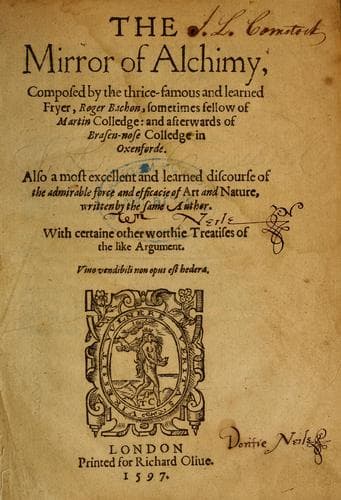
Alchemy -- Early works to 1800; Occultism -- Early works to 1900
Thou must afterward bother, take this precious Stone, which the
Philosophers haue named, magnified, hiddẽ & concealed, & put it in a
_Cucurbit_ with his _Alembick_, & diuide his natures: that is, the
foure elemẽts, the Earth, the Water, the Aire, and the Fire. These are
the body and soule, the spirit and tincture. When thou hast diuided
the water from the earth, and the aire from the fire, keepe both of
them by themselues, and take that which descendeth to the bottom of
the glasse, beeing the lees, and wash it with a warme fire, til his
blacknesse be gone, and his thicknesse departed: then make him very
white, causing the superfluous moysture to flie away, for then hee
shall bee changed and become a white calx, wherein there is no cloudie
darkenesse, nor vncleannesse, and contrarietie. Afterward returne back
to the first natures, which ascended from it, and purifie thẽ likewise
from vncleannes, blacknesse, and contrarietie: and reiterate these
works vpon thẽ so often, vntil they be subtiliate, purified, and made
thin: which when thou hast done, thou shalt acknowledge that God hath
bin gracious vnto thee. Know brother, that this work is one stone,
into which _Gatib_ may not enter, that is to say, any strange thing.
The learned work with this, and from hence proceedeth a medicine that
giueth perfection. There must nothing be mingled herewith, either in
part or whole. This Stone is to be found at all times, in euerie place,
and about euery man, the search whereof is not troublesome to him
that seeketh it, wheresoeuer he be. This Stone is vile, blacke, and
stinking: It costeth nothing: it must bee taken alone: it is somewhat
heauie, and it is called the Originall of the world, because it riseth
vp like things that bud forth. This is his reuelation and apparence to
him that maketh inquirie after it.
CHAP. X.
_Of the nature of the Stone, and his birth._
Take it therefore and worke it as the Philosopher hath told you in his
booke, when he named it after this maner. Take the Stone, no Stone, or
that is not a Stone, neither is of the nature of a Stone. It is a Stone
whose myne is in the top of the mountaines: and here by mountaines, the
Philosopher vnderstandeth liuing creatures, wherupon he saide. Sonne,
go to the mountaines of _India_, and to his caues, & pull out thence
precious stones which will melt in the water when they are putte into
it. And this water is that which is taken from other mountaines and
hollow places. They are stones Sonne, and they are not stones, but we
call them so for a Similitude which they haue to stones. And thou must
know, that the rootes of their mynes are in the ayre, and their tops in
the earth, and it wil easily be heard when they are pluckt out of their
places, for there will be a great noyse. Goe with them my sonne, for
they will quickly vanish away.
CHAP. XI.
_Of the commistion of the Elements that were seperated._
Public-domain text, read in full here on John Shaqi.
Reviews
Reviews
No reviews yet
Be the first to share your thoughts on this work.
Join the Discussion
Join the discussion
Sign in to leave a comment or review.
Sign InorCreate an account