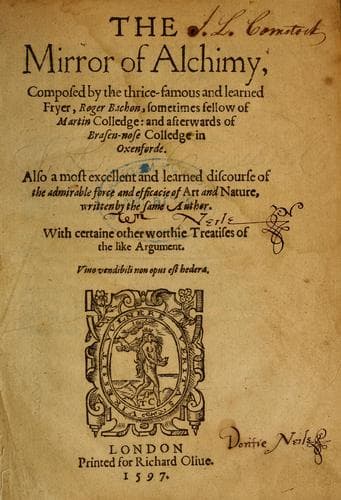
Alchemy -- Early works to 1800; Occultism -- Early works to 1900
thinke, but because it is as nature hath ordained. We must therefore
be verie circumspect in these things: for a man may easily tread awry,
and many erre in both partes. Some denie that there is any operation:
but others exceede and flie vnto Magicke. And hence it is, that there
are so many bookes in the worlde of charmes, and characters, praiers,
coniurations, sacrifices, and such like, that are meere Magicke: as the
booke of the offices of Spirits, the book of the death of the Soule,
the booke of Art notorie, and infinite more of the same kinde, that
containe not in them the power of Art or Nature, but are wholy stuffed
with the idle deuises of vaine magitians. Yet it must be remembred,
that many bookes are ascribed to Magitians, which in truth are not
such, but containe in them the excellencie of wisdome. Now amongst
these, which are suspected, and which not, euerye mans particular
experience shall instruct him. For if in any of them wee can meete
with a worke of Nature or Art, let vs make choyse of that: if not, let
vs leaue it as suspicious, and ill beseeming a wise man. It is the
part of a Magitian so to handle thinges needlesse and superfluous: for
(as _Isaak_ iudgeth in his booke of Feuers) the reasonable Soule is
not hindered in her operations, vnlesse it be detayned by ignoraunce.
And _Aristotle_ sayeth in his booke of Secretes, that in such matter
a sounde and healthy person may doo any thing that is expedient for
men, though not without the influence of diuine vertue: & in the third
of the Meteors, he saith, that there is no vertue, but it cõmeth
from God: and about the latter end of his _Ethicks_, he affirmeth,
that there is no vertue, neither Moral, nor Naturall, endued with a
celestiall vertue, without a diuine and celestiall influence. So that
when we speake of the power of particular agents, we do not exclude
the regiment of the vniuersal agent, and first cause. For euery first
cause hath a greater influence in the thing caused, then the second
cause, as it appeareth by the first proposition of causes.
Public-domain text, read in full here on John Shaqi.
Reviews
Reviews
No reviews yet
Be the first to share your thoughts on this work.
Join the Discussion
Join the discussion
Sign in to leave a comment or review.
Sign InorCreate an account