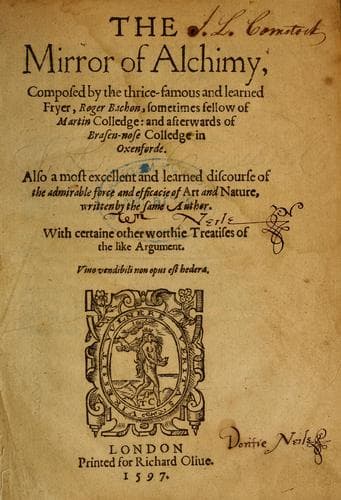
Alchemy -- Early works to 1800; Occultism -- Early works to 1900
And in the beginning when the age of men first began to decline,
a remedie might easily haue beene found out: but after sixe thousand
yeeres and more, it is a difficult matter to prescribe a remedie.
Neuerthelesse, wise men mooued with the foresaid considerations, haue
endeuoured to finde out wayes, not onelye agaynst the defect of euery
particular mans regiment, but also agaynst the corruption of Parents:
not that men should be able to reach vnto the life of _Adam_, or
_Artephius_, by reason of the corruption which daily encreaseth, but
that they might prolong their liues for a hundred yeares or somewhat
more, beyonde the common age of men now liuing, so that the diseases
vsually accompanying olde age, might bee kept backe for a time, and
though not vtterly prohibited and taken quite away, yet they might be
mittigated and diminished, that the life might be profitably prolonged
beyonde the expectation of men, but alwayes within the vtmost bounds
and limits. For there is one tearme of Nature appoynted to the first
men after sinne entered into the worlde, and another alotted to euerye
man by the proper corruption of his parents. These two wee cannot
passe: for though wee may passe the latter, yet are wee not able to
arriue vnto the former: I am of opinion that a wise man may in this
age attaine thereto, the possibilitie and aptnesse of humane nature,
beeing the same nowe that it was in the first men: and no maruaile,
seeing that this aptnesse extendeth it selfe to immortalitie, as it
was before sinne, and shall bee after the resurrection. But if you
say, that neither _Aristotle_, _Plato_, _Hippocrates_, nor _Galen_,
attained hereto. I aunswere, that they were ignoraunt euen of manye
meane vertues, which afterwarde were familiar to those that were
studious. These therefore might easily bee hidden from them, though
they laboured to finde them out: but they busied themselues too much
in other matters, and waxed olde in a trice, spending their life in
base and vulgar things, and yet they were acquainted with many secrets.
For we knowe that _Aristotle_ sayth in the _Predicaments_, that the
quadrature of a Circle may bee knowne, although it bee not yet knowne.
Whereby hee confesseth, that both himselfe, and all men till his time
were ignorant of it. But now a dayes wee see that the truth is knowne,
so that _Aristotle_ might well be ignoraunt of the greatest of Natures
Secrets. And againe, wise men are at this present ignorant of many
things, which the common sort of Students shall knowe hereafter. So
then this obiection is altogether vaine and foolish.
Public-domain text, read in full here on John Shaqi.
Reviews
Reviews
No reviews yet
Be the first to share your thoughts on this work.
Join the Discussion
Join the discussion
Sign in to leave a comment or review.
Sign InorCreate an account