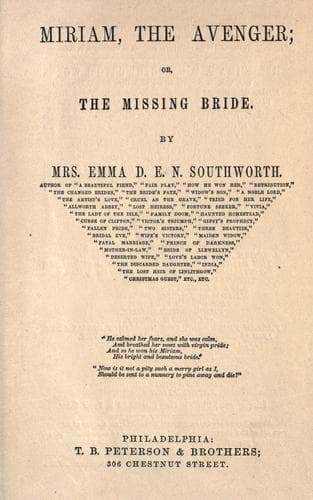
The Missing BrideSouthworth, Emma Dorothy Eliza Nevitte
General
The Missing Bride
Southworth, Emma Dorothy Eliza Nevitte
Fiction
THE MISSING BRIDE
A Novel
by
MRS. E. D. E. N. SOUTHWORTH
Author of _Self-Raised_, _Ishmael_, _Retribution_, _The Bridal Eve_,
_The Bride's Fate_, _Mother-in-Law_, _The Haunted Homestead_, _The
Bride's Dowry_, _Victor's Triumph_, _A Fortune Seeker_, etc.
CHAPTER I.
LUCKENOUGH.
Deep in the primeval forest of St. Mary's, lying between the Patuxent
and the Wicomico Rivers, stands the ancient manor house of Luckenough.
The traditions of the neighborhood assert the origin of the manor and
its quaint, happy and not unmusical name to have been--briefly this:
That the founder of Luckenough was Alexander Kalouga, a Polish soldier
of fortune, some time in the service of Cecilius Calvert, Baron of
Baltimore, first Lord Proprietary of Maryland. This man had, previous to
his final emigration to the New World, passed through a life of the most
wonderful vicissitudes--wonderful even for those days of romance and
adventure. It was said that he was born in one quarter of the globe,
educated in another, initiated into warfare in the third and buried in
the fourth. In his boyhood he was the friend and pupil of Guy Fawkes; he
engaged in the Gunpowder Plot, and after witnessing the terrible fate of
his master, he escaped to Spanish America, where he led for years a sort
of buccaneer life. He afterwards returned to Europe, and then followed
years of military service wherever his hireling sword was needed. But
the soldier of fortune was ill-paid by his mistress. His misfortunes
were as proverbial as his bravery, or as his energetic complaints of
"ill luck" could make them. He had drawn his sword in almost every
quarrel of his time, on every battlefield in Europe, to find himself,
at the end of his military career, no richer than he was at its
beginning--save in wounds and scars, honor and glory, and a wife and
son. It was at this point of his life that he met with Leonard Calvert,
and embarked with him for Maryland, where he afterwards received from
the Lord Proprietary the grant of the manor "aforesaid." It is stated
that when the old soldier went with some companions to take a look at
his new possessions, he was so pleased with the beauty, grandeur,
richness and promise of the place that a glad smile broke over his dark,
storm-beaten, battle-scarred face, and he remained still "smiling as in
delighted visions," until one of his friends spoke and said:
"Well, comrade! Is this luck enough?"
"Yaw, mine frient!" answered the new lord of the manor in his broken
English, cordially grasping the hand of his companion, "dish ish loke
enough!"
Public-domain text, read in full here on John Shaqi.
Reviews
Reviews
No reviews yet
Be the first to share your thoughts on this work.
Join the Discussion
Join the discussion
Sign in to leave a comment or review.
Sign InorCreate an account