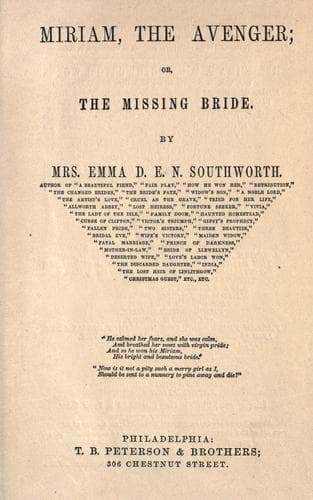
The Missing BrideSouthworth, Emma Dorothy Eliza Nevitte
General
The Missing Bride
Southworth, Emma Dorothy Eliza Nevitte
Fiction
"Knew it!--hope they'll hang him!--d----d rascal! If it hadn't been for
him, there'd been no trouble in the family! Now call Festus to help to
turn me over, and tuck me up, Henrietta; I want to go to sleep!"
That night Mrs. Waugh said nothing, but the next morning she proposed
hurrying homeward with all possible speed.
But the commodore would hear of no such thing. He swore roundly that he
would not stir to save the necks of all the scoundrels in the world,
much less that of Thurston, who, if he did not kill Marian, deserved
richly to be hanged for giving poor Nace so much trouble.
Mrs. Waugh coaxed and urged in vain. The commodore rather liked to hear
her do so, and so the longer she pleaded, the more obstinate and dogged
he grew, until at last Henrietta desisted--telling him, very
well!--justice and humanity alike required her presence near the unhappy
man, and so, whether the commodore chose to budge or not, she should
surely leave Charleston in that very evening's boat for Baltimore, so as
to reach Leonardtown in time for the trial. Upon hearing this, the
commodore swore furiously; but knowing of old that nothing could turn
Henrietta from the path of duty, and dreading above all things to lose
her comfortable attentions, and be left to the doubtful mercies of Mary
L'Oiseau, he yielded, though with the worst possible grace, swearing all
the time that he hoped the villain would swing for it yet.
And then the trunks were packed, and the travelers resumed their
homeward journey.
CHAPTER XXXVI.
THE TRIAL.
The day of the trial came. It was a bright spring day, and from an early
hour in the morning the village was crowded to overflowing with people
collected from all parts of the county. The court-room was filled to
suffocation. It was with the greatest difficulty that order could be
maintained when the prisoner, in the custody of the high sheriff, was
brought into court.
The venerable presiding judge was supposed to be unfriendly to the
accused, and the State's Attorney was known to be personally, as well as
officially, hostile to his interests. So strongly were the minds of the
people prejudiced upon one side or the other that it was with much
trouble that twelve men could be found who had not made up their
opinions as to the prisoner's innocence or guilt. At length, however, a
jury was empaneled, and the trial commenced. When the prisoner was
placed at the bar, and asked the usual question, "Guilty or not guilty?"
some of the old haughtiness curled the lip and flashed from the eye of
Thurston Willcoxen, as though he disdained to answer a charge so base;
and he replied in a low, scornful tone:
"Not guilty, your honor."
Public-domain text, read in full here on John Shaqi.
Reviews
Reviews
No reviews yet
Be the first to share your thoughts on this work.
Elsewhere in the archive
Join the Discussion
Join the discussion
Sign in to leave a comment or review.
Sign InorCreate an account