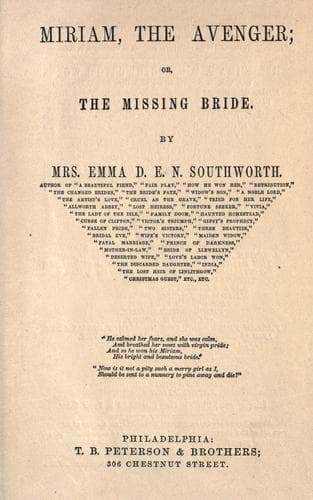
The Missing BrideSouthworth, Emma Dorothy Eliza Nevitte
General
The Missing Bride
Southworth, Emma Dorothy Eliza Nevitte
Fiction
The opening charge of the State's Attorney had been carefully prepared.
Mr. Thomson had never in his life had so important a case upon his
hands, and he was resolved to make the most of it. His speech was well
reasoned, logical, eloquent. To destroy in the minds of the jury every
favorable impression left by the late blameless and beneficent life of
Mr. Willcoxen, he did not fail to adduce, from olden history, and from
later times, every signal instance of depravity, cloaked with hypocrisy,
in high places; he enlarged upon wolves in sheeps' clothing--Satan in an
angel's garb, and dolefully pointed out how many times the indignant
question of--"Is thy servant a dog, that he should do this thing?"--had
been answered by results in the affirmative. He raked up David's sin
from the ashes of ages. Where was the scene of that crime, and who was
its perpetrator--in the court of Israel, by the King of Israel--a man
after God's own heart. Could the gentlemen of the jury be surprised at
the appalling discovery so recently made, as if great crimes in high
places were impossible or new things under the sun? He did not fail to
draw a touching picture of the victim, the beautiful, young
stranger-girl, whom they all remembered and loved--who had come, an
angel of mercy, on a mission of mercy, to their shores. Was not her
beauty, her genius, her goodness--by which all there had at some time
been blessed--sufficient to save her from the knife of the assassin? No!
as he should shortly prove. Yet all these years her innocent blood had
cried to Heaven in vain; her fate was unavenged, her _manes_ unappeased.
All the women, and all the simple-hearted and unworldly among the men,
were melted into tears, very unpropitious to the fate of Thurston; tears
not called up by the eloquence of the prosecuting attorney, so much as
by the mere allusion to the fate of Marian, once so beloved, and still
so fresh in the memories of all.
Thurston heard all this--not in the second-hand style with which I have
summed it up--but in the first vital freshness, when it was spoken with
a logic, force, and fire that carried conviction to many a mind.
Thurston looked upon the judge--his face was stern and grave. He looked
upon the jury--they were all strangers, from distant parts of the
county, drawn by idle curiosity to the scene of trial, and arriving
quite unprejudiced. They were not his "peers," but, on the contrary,
twelve as stolid-looking brothers as ever decided the fate of a
gentleman and scholar. Thence he cast his eyes over the crowd in the
court-room.
Public-domain text, read in full here on John Shaqi.
Reviews
Reviews
No reviews yet
Be the first to share your thoughts on this work.
Elsewhere in the archive
Join the Discussion
Join the discussion
Sign in to leave a comment or review.
Sign InorCreate an account