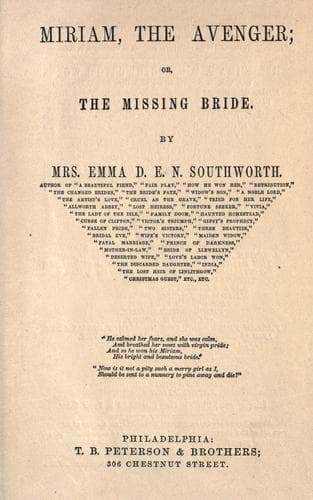
The Missing BrideSouthworth, Emma Dorothy Eliza Nevitte
General
The Missing Bride
Southworth, Emma Dorothy Eliza Nevitte
Fiction
Thurston Willcoxen, when he heard this astounding evidence, first
thought that the witness was perjured, but when he looked closely upon
his open, honest face, and fearless eye and free bearing, he saw that no
consciousness of falsehood was there and he could but grant that the
witness, naturally deceived by "foregone conclusions," had inevitably
mistaken the real murderer for himself.
Darker and darker lowered the pall of fate over him--the awful stillness
of the court was oppressive, was suffocating; a deathly faintness came
upon him, for now, for the first time, he fully realized the awful doom
that threatened him. Not long his nature bowed under the burden--his
spirit rose to throw it off, and once more the fine head was proudly
raised, nor did it once sink again. The last witness for the prosecution
was called and took the stand, and deposed that he lived ten miles down
the coast in an isolated, obscure place; that on the first of May, 182-,
the body of a woman had been found at low tide upon the beach, that it
had the appearance of having been very long in the water--the clothing
was respectable, the dress was dark blue stuff, but was faded in
spots--there was a ring on the finger, but the hand was so swollen that
it could not be got off. His poor neighbors of the coast assembled. They
made an effort to get the coroner, but he could not be found. And the
state of the body demanded immediate burial. When cross-questioned by
Lawyer Romford, the witness said that they had not then heard of any
missing or murdered lady, but had believed the body to be that of a
shipwrecked passenger, until they heard of Miss Mayfield's fate.
Miriam was next recalled. She came in as before, supported between
Colonel and Miss Thornton. Every one who saw the poor girl, said that
she was dying. When examined, she deposed that Marian, when she left
home, had worn a blue merino dress--and, yes, she always wore a little
locket ring on her finger. Drooping and fainting as she was, Miriam was
allowed to leave the court-room. This closed the evidence of the
prosecution.
The defense was taken up and conducted with a great deal of skill. Mr.
Romford enlarged upon the noble character his client had ever maintained
from childhood to the present time--they all knew him--he had been born
and had ever lived among them--what man or woman of them all would have
dared to suspect him of such a crime? He spoke warmly of his truth,
fidelity, Christian zeal, benevolence, philanthropy and great public
benefits.
Public-domain text, read in full here on John Shaqi.
Reviews
Reviews
No reviews yet
Be the first to share your thoughts on this work.
Elsewhere in the archive
Join the Discussion
Join the discussion
Sign in to leave a comment or review.
Sign InorCreate an account