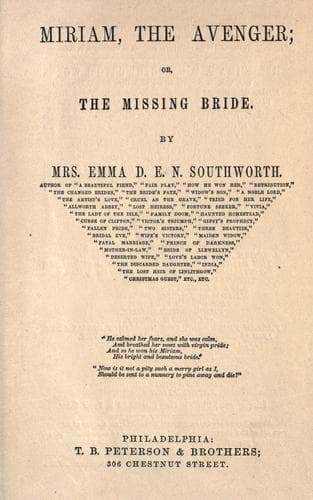
The Missing BrideSouthworth, Emma Dorothy Eliza Nevitte
General
The Missing Bride
Southworth, Emma Dorothy Eliza Nevitte
Fiction
I have no space nor time to give a fair idea of the logic and eloquence
with which Mr. Romford met the charges of the State's Attorney, nor the
astute skill with which he tried to break down the force of the evidence
for the prosecution. Then he called the witnesses for the defense. They
were all warm friends of Mr. Willcoxen, all had known him from boyhood,
none would believe that under any possible circumstances he could commit
the crime for which he stood indicted. They testified to his well-known
kindness, gentleness and benevolence--his habitual forbearance and
command of temper, even under the most exasperating provocations--they
swore to his generosity, fidelity and truthfulness in all the relations
of life. In a word, they did the very best they could to save his life
and honor--but the most they could do was very little before the force
of such evidence as stood arrayed against him. And all men saw that
unless an _alibi_ could be proved, Thurston Willcoxen was lost! Oh! for
that _alibi_. Paul Douglass was again undergoing an awful temptation.
Why, he asked himself, why should he not perjure his soul, and lose it,
too, to save his brother's life and honor from fatal wrong? And if there
had not been in Paul's heart a love of truth greater than his fear of
hell, his affection for Thurston would have triumphed, he would have
perjured himself.
The defense here closed. The State's Attorney did not even deem it
necessary to speak again, and the judge proceeded to charge the jury.
They must not, he said, be blinded by the social position, clerical
character, youth, talents, accomplishments or celebrity of the
prisoner--with however dazzling a halo these might surround him. They
must deliberate coolly upon the evidence that had been laid before them,
and after due consideration of the case, if there was a doubt upon their
minds, they were to let the prisoner have the full benefit of
it--wherever there was the least uncertainty it was right to lean to the
side of mercy.
The case was then given to the jury. The jury did not leave their box,
but counseled together in a low voice for half an hour, during which a
death-like silence, a suffocating atmosphere filled the court-room.
Thurston alone was calm, his soul had collected all its force to meet
the shock of whatever fate might come--honor or dishonor, life or death!
Presently the foreman of the jury arose, followed by the others.
Every heart stood still.
"Gentlemen of the jury, have you agreed upon your verdict?" demanded the
judge.
"Yes, your honor," responded the foreman, on the part of his colleagues.
"How say you--is the prisoner at the bar 'Guilty or not guilty?'"
Public-domain text, read in full here on John Shaqi.
Reviews
Reviews
No reviews yet
Be the first to share your thoughts on this work.
Elsewhere in the archive
Join the Discussion
Join the discussion
Sign in to leave a comment or review.
Sign InorCreate an account