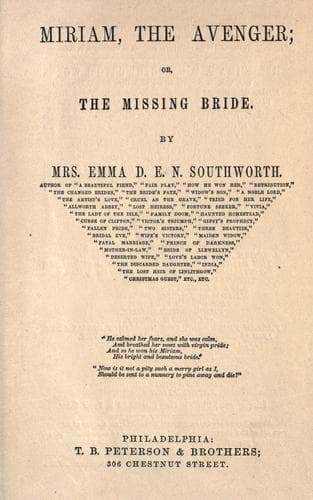
The Missing BrideSouthworth, Emma Dorothy Eliza Nevitte
General
The Missing Bride
Southworth, Emma Dorothy Eliza Nevitte
Fiction
"No, madam, no kin to him--and yet more than kin--for he loved me, and I
loved him more than any one else in the world, as I now love his poor
young widow. This was the way of it, Mrs. Waugh: Michael's father and my
mother had both been married before, and we were children of the first
marriages; when Michael was fourteen years old, and I was seven, our
parents were united, and we grew up together. About two years ago,
Michael's father died. My mother survived him only five months, and
departed, leaving me in charge of her stepson. We had no friends but
each other. Our parents, since their union, had been isolated beings,
for this reason--his father was a Jew--my mother a Christian--therefore
the friends and relatives on either side were everlastingly offended by
their marriage. Therefore we had no one but each other. The little
property that was left was sold, and the proceeds enabled Michael to
purchase a commission in the regiment about to sail for America, and
also to place me at a good boarding school, where I remained until his
return, and the catastrophe that followed it.
"Lady, all passed so suddenly, that I knew no word of his return, much
less of his trial or execution, until I received a visit from the
chaplain who had attended his last moments, and who brought me his
farewell letter, and his last informal will, in which the poor fellow
consigned me to the care of his wife, soon to be a widow, and enjoined
me to leave school and seek her at once, and inclosed a check for the
little balance he had in bank. I went immediately, found her insensible
through grief, as I said--and, lady, I told you the rest."
Henrietta was weeping softly behind the handkerchief she held at her
eyes. At last she repeated:
"You say he left you in his widow's charge?"
"Yes, madam."
"Left his widow in yours, rather, you good and faithful sister."
"It was the same thing, lady; we were to live together, and to support
each other."
"But what was your thought, my dear girl, in bringing her here?"
"I told you, lady, that in her own native land, among her own kinsfolk,
she might be comforted, and might resume her girlhood's thoughts and
habits, and learn to forget the strange, dark passages of her short
married life, passed in a foreign country."
"But, my dear girl, did you not know, had you never heard that her uncle
disowned her for marrying against his will?"
"Something of that I certainly heard from Edith, lady, when I first
proposed to her to come home. But she was very weak, and her thoughts
very rambling, poor thing--she could not stick to a point long, and I
overruled and guided her--I could not believe but that her friends would
take her poor widowed heart to their homes again. But if it should be
otherwise, still--"
"Well?--still?"
Public-domain text, read in full here on John Shaqi.
Reviews
Reviews
No reviews yet
Be the first to share your thoughts on this work.
Join the Discussion
Join the discussion
Sign in to leave a comment or review.
Sign InorCreate an account