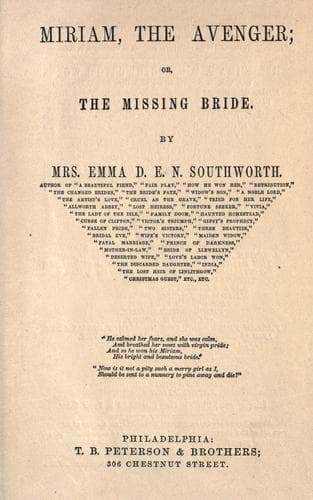
The Missing BrideSouthworth, Emma Dorothy Eliza Nevitte
General
The Missing Bride
Southworth, Emma Dorothy Eliza Nevitte
Fiction
Delicate, dreamy and retiring, and tinged with a certain pensiveness,
the effect of too much early sorrow and seclusion upon a very sensitive
temperament, Edith better loved the solitude of the grand old forest of
St. Mary's or the loneliness of her own shaded rooms at Luckenough than
any society the humdrum neighborhood could offer her. And when at the
call of social duty she did go into company, she exercised a refining
and subduing influence, involuntary as it was potent.
Yet in that lovely, fragile form, in that dreaming, poetical soul, lay
undeveloped a latent power of heroism soon to be aroused into action.
"Darling of all hearts and eyes," Edith had been at home a year when the
War of 1812 broke out.
Maryland, as usual, contributed her large proportion of volunteers to
the defense of the country. All men capable of bearing arms rapidly
mustered into companies and hastened to put themselves at the disposal
of the government.
The lower counties of Maryland were left comparatively unprotected. Old
men, women, children and negroes were all that remained in charge of the
farms and plantations. Yet remote from the scenes of conflict and
hitherto undisturbed by the convulsions of the great world, they reposed
in fancied safety and never thought of such unprecedented misfortunes as
the evils of the war penetrating to their quiet homes.
But their rest of security was broken by a tremendous shock. The British
fleet under Admiral Sir A. Cockburn suddenly entered the Chesapeake. And
the quiet, lonely shores of the bay became the scene of a warfare
scarcely paralleled in atrocity in ancient or modern times.
If among the marauding band of licensed pirates and assassins there was
one name more dreaded, more loathed and accursed than the rest, it was
that of the brutal and ferocious Thorg--the frequent leader of foraging
parties, the unsparing destroyer of womanhood, infancy and age, the
jackal and purveyor of Admiral Cockburn. If anywhere there was a
beautiful woman unprotected, or a rich plantation house ill-defended,
this jackal was sure to scent out "the game" for his master, the lion.
And many were the comely maidens and youthful wives seized and carried
off by this monster.
The Patuxent and the Wicomico, with the coast between them, offered no
strong temptation to a rapacious foe, and the inhabitants reposed in the
fancied security of their isolation and unimportance. The business of
life went on, faintly and sorrowfully, to be sure, but still went on.
The village shops at B---- and C---- were kept open, though tended
chiefly by women and boys. The academicians at the little college
pursued their studies or played at forming juvenile military companies.
The farms and plantations were cultivated chiefly under the direction of
ladies whose husbands, sons and brothers were absent with the army. No
one thought of danger to St. Mary's.
Public-domain text, read in full here on John Shaqi.
Reviews
Reviews
No reviews yet
Be the first to share your thoughts on this work.
Join the Discussion
Join the discussion
Sign in to leave a comment or review.
Sign InorCreate an account