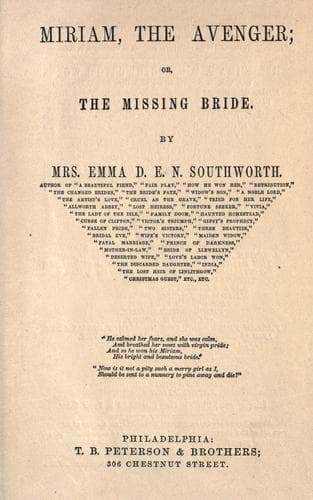
The Missing BrideSouthworth, Emma Dorothy Eliza Nevitte
General
The Missing Bride
Southworth, Emma Dorothy Eliza Nevitte
Fiction
Five years had made very little alteration here, excepting in the case
of Jacquelina, who had grown up to be the most enchanting sprite that
ever bewitched the hearts, or turned the heads of men. She was petite,
slight, agile, graceful; clustering curls of shining gold encircled a
round, white forehead, laughing in light; springs under springs of fun
and frolic sparkled up from the bright, blue eyes, whose flashing light
flew bird-like everywhere, but rested nowhere. She seemed even less
human and irresponsible than when a child--verily a being of the air,
a fairy, without human thoughtfulness, or sympathy, or affections! She
only seemed so--under all that fay-like levity there was a heart. Poor
heart! little food or cultivation had it had in all its life.
For who had been Jacquelina's educators?
First, there was the commodore, with his alternations of blustering
wrath and foolish fondness, giving way to his anger, or indulging his
love, without the slightest regard to the effect produced upon his young
ward--too often abusing her for something really admirable in her
nature--and full as frequently praising her for something proportionately
reprehensible in her conduct.
Next, there was the dark, and solemn, and fanatical Dr. Grimshaw, her
destined bridegroom, who really and truly loved the child to fatuity,
and conscientiously did the very best he could for her mental and moral
welfare, according to his light. Alas! "when the light that is in one is
darkness, how great is that darkness!" Jacquelina rewarded his serious
efforts with laughter, and flattered him with the pet names of Hobgoblin,
Ghoul, Gnome, Ogre, etc. Yet she did not dislike her solemn suitor--she
never had taken the matter so seriously as that! And he on his part bore
the eccentricities of the elf with matchless patience, for he loved her,
as I said, to fatuity--doted on her with a passion that increased with
ripening years, and of late consumed him like a fever.
And then there was her mother, last named because, whatever she should
have been, she really was the least important of Jacquelina's teachers.
Fear was the key-note of Mrs. L'Oiseau's character--the key-stone in the
arch of her religious faith--she feared everything--the opinion of the
world, the unfaithfulness of friends, changes in the weather, reverses
of fortune, pain, sickness, sorrow, want, labor!
Now the time had not yet come for this proposed marriage to shock the
merry maiden. She was "ower young to marry yet."
So thought not the commodore; for a year past, since his niece had
attained the age of fourteen, he had been worrying himself and the
elders of the family to have the marriage solemnized, "before the little
devil shall have time to get some other notion into her erratic head,"
he said. All were opposed to him, holding over his head the only rod he
dreaded, the opinion of the world.
"What would people say if you were to marry your niece of fourteen to a
man of thirty-four?" they urged.
Public-domain text, read in full here on John Shaqi.
Reviews
Reviews
No reviews yet
Be the first to share your thoughts on this work.
Join the Discussion
Join the discussion
Sign in to leave a comment or review.
Sign InorCreate an account