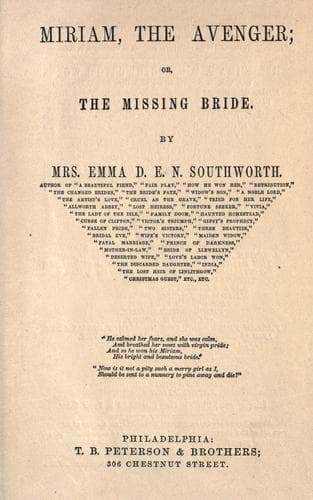
The Missing BrideSouthworth, Emma Dorothy Eliza Nevitte
General
The Missing Bride
Southworth, Emma Dorothy Eliza Nevitte
Fiction
The oldest and nearest kinsman and natural guardian of the boys--old Mr.
Willcoxen--had, of course, received them into his house to be reared and
educated; but no education would he afford the lads beyond that
dispensed by the village schoolmaster, who could very well teach them
that ten dimes make a dollar, and ten dollars an eagle; and who could
also instruct them how to write their own names--for instance, at the
foot of receipts of so many hundred dollars for so many hogsheads of
tobacco; or to read other men's signatures, to wit, upon the backs of
notes of hand, payable at such a time, or on such a day. This was just
knowledge enough, he said, to teach the boys how to make and save money,
yet not enough to tempt them to spend it foolishly in travel, libraries,
pictures, statues, arbors, fountains, and such costly trumpery and
expensive tomfoolery.
To Thurston, who was his favorite, probably because he bore the family
name and inherited some independent property, Mr. Willcoxen would,
however, have afforded a more liberal and gentlemanly education, could
he have done so and at the same time decently withheld from going to
some expense in giving his penniless grandson, Cloudy, the same
privilege. As it was, he sought to veil his parsimony by conservative
principle.
It was a great humiliation to the boys to see that, while all the youths
of their own rank and neighborhood were entered pensioners at the local
college, they two alone were taken from the little day-school to be put
to agricultural labor--a thing unprecedented in that locality at that
time.
When this matter was brought to the knowledge of Commodore Waugh, as he
strode up and down his hall, the indignant old sailor thumped his heavy
stick upon the ground, thrust forward his great head, and swore
furiously by the whole Pandemonial Hierarchy that his grandnephews
should not be brought up like clodhoppers.
And straightway he ordered his carriage, threw himself into it, and rode
over to Charlotte Hall, where he entered the name of his two young
relatives as pensioners at his own proper cost.
This done, he ordered his coachman to take the road to Dell-Delight,
where he had an interview with Mr. Willcoxen.
And as he met little opposition from the old man, who seemed to think
that it was no more than fair that the boys' uncle should share the
expense of educating them, he sought out the youths, whom he found in
the field, and bade them leave the plough, and go and prepare themselves
to go to C---- and get educated, as befitted the grandnephews of a
gentleman!
Public-domain text, read in full here on John Shaqi.
Reviews
Reviews
No reviews yet
Be the first to share your thoughts on this work.
Join the Discussion
Join the discussion
Sign in to leave a comment or review.
Sign InorCreate an account