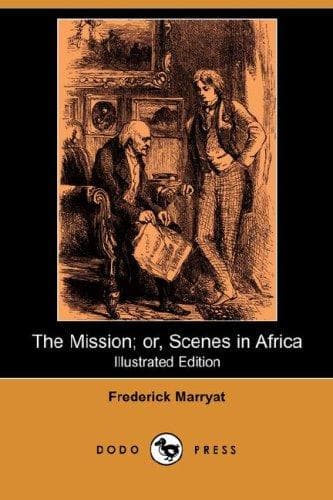
The Mission; or Scenes in AfricaMarryat, Frederick
General
The Mission; or Scenes in Africa
Marryat, Frederick
Adventure stories; Africa -- Fiction
This was a heavy blow with which it pleased God to visit him in his
prosperity, and was almost a total wreck of all his hopes and
anticipations. But he was a good man and a religious one, and he bowed
in humility to the dispensation, submitting with resignation to his
loss, and still thankful to Heaven that it had graciously spared one of
the objects of his affections to console him, and to watch his declining
years.
Sir Charles Wilmot took possession of the family mansion and estate in
Berkshire, in which he was still residing at the time that our history
commences. By degrees he became more resigned, and waited with anxiety
for the return of his only daughter, who now seemed more dear to him
than ever. He employed himself in making preparations for her
reception, fitting up her apartments in the Oriental style which she had
been accustomed to, and devising every little improvement and invention
which he thought would give pleasure to a child of ten years old.
But it pleased Heaven that Sir Charles should be more severely
chastised: the _Grosvenor's_ time of arrival had elapsed, and still she
was not reported in the Channel; week after week of anxiety and suspense
passed slowly away, and the East-India ship did not make her appearance.
It was supposed that she had been captured by the enemy, but still no
tidings of her capture were received. At length, however, this state of
anxiety and doubt was put an end to by the dreadful intelligence that
the ship had been wrecked on the east coast of Africa, and that nearly
the whole of the crew and passengers had perished. Two men belonging to
her had been brought home by a Danish East-Indiaman, and shortly after
the first intelligence, these men arrived in London, and gave a more
particular detail of what had occurred.
Sir Charles, in a state of feverish anxiety, as soon as he heard of
their arrival, hastened up to town to question these men; and the result
of his interrogatories fully convinced him that he was now quite
bereaved and childless. This was the last blow and the most severe; it
was long before he could resign himself to the unsearchable
dispensations of Providence; but time and religion had at last overcome
all his repining feelings,--all disposition to question the goodness or
wisdom of his Heavenly Father, and he was enabled to say, with
sincerity, "Not my will, but thine, be done."
But although Sir Charles was thus left childless, as years passed away,
he at last found that he had those near to him for whom he felt an
interest, and one in particular who promised to deserve all his regard.
This was his grand-nephew, Alexander Wilmot, who was the legal heir to
the title and entailed property,--the son of a deceased nephew, who had
fallen during the Peninsular war.
Public-domain text, read in full here on John Shaqi.
Reviews
Reviews
No reviews yet
Be the first to share your thoughts on this work.
Join the Discussion
Join the discussion
Sign in to leave a comment or review.
Sign InorCreate an account