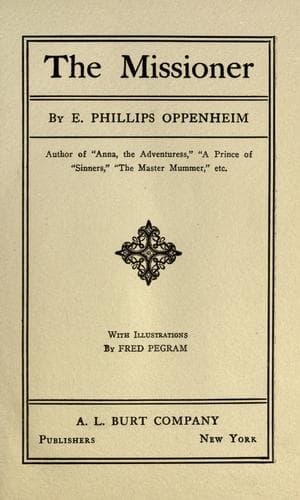
The MissionerOppenheim, E. Phillips (Edward Phillips)
Religion
The Missioner
Oppenheim, E. Phillips (Edward Phillips)
Detective and mystery stories
"The two," he answered pleasantly, "are not incompatible."
Wilhelmina frowned.
"I hope," she said, "that you have abandoned your idea of holding
meetings in the village."
"Certainly not," he answered. "I will begin next week."
"You understand," she said calmly, "that I consider you--as a
missioner--an intruder--here! Those of my people who attend your
services will incur my displeasure!"
"Madam," he answered, "I do not believe that you will visit it upon
them."
"But I will," she interrupted ruthlessly. "You are young and know little
of the world. You have not yet learnt the truth of one of the oldest of
proverbs--that it is well to let well alone!"
"It is a sop for the idle, that proverb," he answered. "It is the motto
for the great army of those who drift."
"I have been making inquiries," she said. "I find that my villagers are
contented and prosperous. There are no signs of vice in the place."
"There is such a thing," he answered, "as being too prosperous,
over-contented. The person in such a state takes life for granted.
Religion is a thing he hears about, but fails to realize. He has no need
of it. He becomes like the prize cattle in your park! He has a mind, but
has forgotten how to use it."
She looked at him steadily, perhaps a trifle insolently.
"How old are you, Mr. Macheson?" she asked.
"Twenty-eight," he answered, with a slight flush.
"Twenty-eight! You are young to make yourself the judge of such things
as these. You will do a great deal of mischief, I am afraid, before you
are old enough to realize it."
"To awaken those who sleep in the daytime--is that mischief?" he asked.
"It is," she answered deliberately. "When you are older you will realize
it. Sleep is the best."
He bent towards her. The light in his eyes had blazed out.
"You know in your heart," he said, "that it is not true. You have
brains, and you are as much of an artist as your fettered life permits
you to be. You know very well that knowledge is best."
"Do you believe," she answered, "that I--I take myself not personally
but as a type--am as happy as they are?"
She moved her parasol to where the village lay beyond the trees. He
hesitated.
"Madam," he answered gravely, "I know too little of your life to answer
your question."
She shrugged her shoulders. For a moment her parasol hid her face.
"We are quite _à la mode_, are we not, my dear Peggy?" she remarked,
with a curious little laugh. "Philosophy upon the village green.
Gilbert, tell them to drive on."
She turned deliberately to Macheson.
"Come and convert us instead," she said. "We need it more."
"I do not doubt it, madam," he answered. "Good afternoon!"
The carriage drove off. Macheson, obeying an impulse which he did not
recognize, watched it till it was out of sight. At the bend, Wilhelmina
deliberately turned in her seat and saw him standing there. She waved
her parasol in ironical farewell, and Macheson walked back to the tent
with burning cheeks.
CHAPTER VII
Public-domain text, read in full here on John Shaqi.
Reviews
Reviews
No reviews yet
Be the first to share your thoughts on this work.
Join the Discussion
Join the discussion
Sign in to leave a comment or review.
Sign InorCreate an account