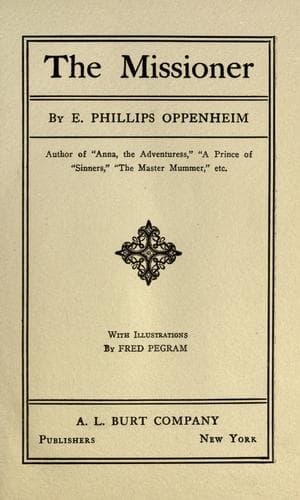
The MissionerOppenheim, E. Phillips (Edward Phillips)
Religion
The Missioner
Oppenheim, E. Phillips (Edward Phillips)
Detective and mystery stories
He left the place by a side entrance, and rode slowly down the private
road, fringed by a magnificent row of elm trees, to the village. The
latch of the iron gate at the end of the avenue was stiff, and he failed
to open it with his hunting crop at the first attempt. Just as he was
preparing to try again, a tall, boyish-looking young man, dressed in
sombre black, came swiftly across the road and opened the gate. Mr. Hurd
thanked him curtly, and the young man raised his hat.
"You are Mr. Hurd, I believe?" he remarked. "I was going to call upon
you this afternoon."
The little man upon the pony frowned. He had no doubt as to his
questioner.
"My name is Hurd, sir," he answered stiffly. "What can I do for you?"
"You can let me have that barn for my services," the other answered
smiling. "I wrote you about it, you know. My name is Macheson."
Mr. Hurd's answer was briefly spoken, and did not invite argument.
"I have mentioned the matter to Miss Thorpe-Hatton, sir. She agrees with
me that your proposed ministrations are altogether unneeded in this
neighbourhood."
"You won't let me use the barn, then?" the young man remarked
pleasantly, but with some air of disappointment.
Mr. Hurd gathered up the reins in his hand.
"Certainly not, sir!"
He would have moved on, but his questioner stood in the way. Mr. Hurd
looked at him from underneath his shaggy eyebrows. The young man was
remarkably young. His smooth, beardless face was the face of a boy. Only
the eyes seemed somehow to speak of graver things. They were very bright
indeed, and they did not falter.
"Mr. Hurd," he begged, "do let me ask you one question! Why do you
refuse me? What harm can I possibly do by talking to your villagers?"
Mr. Hurd pointed with his whip up and down the country lane.
"This is the village of Thorpe, sir," he answered. "There are no poor,
there is no public-house, and there, within a few hundred yards of the
farthest cottage," he added, pointing to the end of the street, "is the
church. You are not needed here. That is the plain truth."
The young man looked up and down, at the flower-embosomed cottages, with
their thatched roofs and trim appearance, at the neatly cut hedges, the
well-kept road, the many signs of prosperity. He looked at the little
grey church standing in its ancient walled churchyard, where the road
divided, a very delightful addition to the picturesque beauty of the
place. He looked at all these things and he sighed.
"Mr. Hurd," he said, "you are a man of experience. You know very well
that material and spiritual welfare are sometimes things very far
apart."
Mr. Hurd frowned and turned his pony's head towards home.
"I know nothing of the sort, sir," he snapped. "What I do know is that
we don't want any Salvation Army tricks here. You should stay in the
cities. They like that sort of thing there."
"I must come where I am sent, Mr. Hurd," the young man answered. "I
cannot do your people any harm. I only want to deliver my message--and
go."
Public-domain text, read in full here on John Shaqi.
Reviews
Reviews
No reviews yet
Be the first to share your thoughts on this work.
Join the Discussion
Join the discussion
Sign in to leave a comment or review.
Sign InorCreate an account