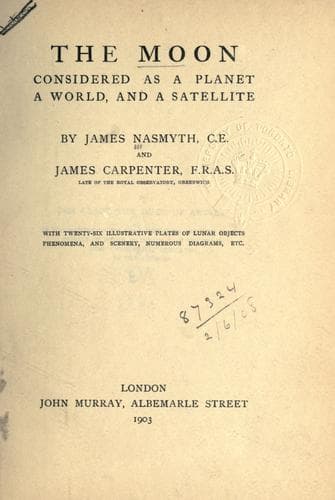
The Moon: considered as a planet, a world, and a satellite.Nasmyth, James
Science
The Moon: considered as a planet, a world, and a satellite.
Nasmyth, James
Moon
Those who have offered other explanations of these vast ring-formed
mountain ranges, have been no more happy in their conjectures. M. Rozet,
who communicated a paper on selenology to the French Academy in 1846,
put forth the following theory. He argued that during the formation of
the solid scoriaceous pelicules of the moon, circular or tourbillonic
movements were set up; and these, by throwing the scoria from the centre
to the circumference, caused an accumulation thereof at the limit of the
circulation. He considered that this phenomenon continued during the
whole process of solidification, but that the amplitude of the whirlpool
diminished with the decreasing fluidity of the surface material.
Further, he suggested that when many vortices were formed, and the
distances of their centres, taken two and two, were less than the sums
of their radii, there resulted closed spaces terminated by arcs of
circles; and when for any two centres the distance was greater than the
sum of the radii of action, two separate and complete rings were formed.
We have only to remark on this, that we are at a loss to account for the
origination of such vorticose movements, and M. Rozet is silent on the
point. If the great circles are to be referred to an original sea of
molten matter, it appears to us more feasible to consider that wherever
we see one of them there has been, at the centre of the ring, a great
outflow of lava that has flooded the surrounding surface. Then, if from
any cause, and it is not difficult to assign one, the outflow became
intermittent, or spasmodic, or subject to sudden impulses, concentric
waves would be propagated over the pool and would throw up the scoria or
the solidifying lava in a circular bank at the limit of the fluid area.
Public-domain text, read in full here on John Shaqi.
Reviews
Reviews
No reviews yet
Be the first to share your thoughts on this work.
Elsewhere in the archive
Join the Discussion
Join the discussion
Sign in to leave a comment or review.
Sign InorCreate an account