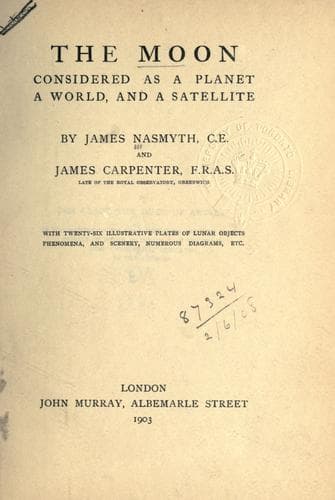
The Moon: considered as a planet, a world, and a satellite.Nasmyth, James
Science
The Moon: considered as a planet, a world, and a satellite.
Nasmyth, James
Moon
This hypothesis does not differ greatly from the _ebullition_ theory
proposed by Professor Dana, the American geologist, to explain these
formations. He considered that the lunar ring-mountains were formed by
an action analogous to that which is exemplified on the earth in the
crater of Kilauea, in the Hawaiian islands. This crater is a large open
pit exceeding three miles in its longer diameter, and nearly a thousand
feet deep. It has clear bluff walls round a greater part of its circuit,
with an inner ledge or plain at their base, raised 340 feet above the
bottom. This bottom is a plain of solid lavas, entirely open to day,
which may be traversed with safety (we are quoting Professor Dana’s own
statement written in 1846, and therefore not correctly applying to the
present time): over it there are pools of boiling lava in active
ebullition, and one is more than a thousand feet in diameter. There are
also cones at times, from a few yards to two or three thousand feet in
diameter, and varying greatly in angle of inclination. The largest of
these cones have a circular pit or crater at the summit. The great pit
itself is oblong, owing to its situation on a fissure, but the lakes
upon its bottom are round, and in them, says Professor Dana, “the
circular or slightly elliptical form of the moon’s craters is
exemplified to perfection.”
Now Dana refers this great pit crater and its contained lava-lakes to
“the fact that the action at Kilauea is simply _boiling_, owing to the
extreme fluidity of the lavas. The gases or vapours which produce the
state of active ebullition escape freely in small bubbles, with little
commotion, like jets over boiling water; while at Vesuvius and other
like cones they collect in immense bubbles before they accumulate force
enough to make their way through; and consequently the lavas in the
latter case are ejected with so much violence that they rise to a height
often of many thousand feet and fall around in cinders. This action
builds up the pointed mountain, while the simple boiling of Kilauea
makes no cinders and no cinder cones.”
Professor Dana continues, “If the fluidity of lavas, then, is sufficient
for this active ebullition, we may have boiling going on over an area of
an indefinite extent; for the size of a boiling lake can have no limits
except such as may arise from a deficiency of heat. The size of the
lunar craters is therefore no mystery. Neither is their circular form
difficult of explanation; for a boiling pool necessarily, by its own
action, extends itself circularly around its centre. The combination of
many circles, and the large sea-like areas are as readily
understood.”[10]
Public-domain text, read in full here on John Shaqi.
Reviews
Reviews
No reviews yet
Be the first to share your thoughts on this work.
Elsewhere in the archive
Join the Discussion
Join the discussion
Sign in to leave a comment or review.
Sign InorCreate an account