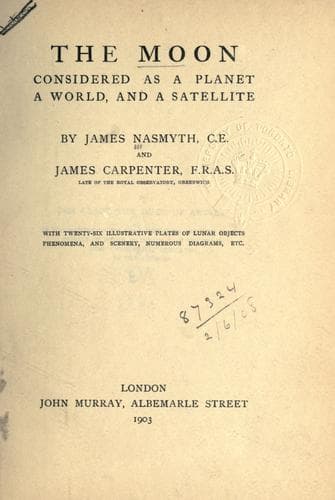
The Moon: considered as a planet, a world, and a satellite.Nasmyth, James
Science
The Moon: considered as a planet, a world, and a satellite.
Nasmyth, James
Moon
Isolated peaks are found in small numbers upon the moon; there are a few
striking examples of them nevertheless, and these are chiefly situated
in the mountainous region just alluded to. Several are seen to the east
(right hand) of the Alpine range depicted on Plate XIV. The best known
of these is Pico, which rises abruptly from a generally smooth plain to
a height of 7000 feet. It may be recognized as the lower of the two long
shadowing spots located almost centrally above the crater Plato in the
illustration just mentioned. Above it, at an actual distance of 40
miles, there is another peak (unnamed) about 4000 feet high; and away to
the west, beyond the small crater joined by a hill-ridge to Plato, is a
third pyramidal mountain nearly as high as Pico.
It seems natural to regard the great mountain chains as agglomerations
of those peaks of which we have isolated examples in Pico and its
compeers, and thus to consider that the formation of a mountain chain
has been a multiplication of the process that formed the single
pyramid-shaped eminences. At first thought it might appear that the
great mountain ranges were produced by bodily upthrustings of the crust
of the moon by some subsurface convulsions. But such an explanation
could hardly hold in relation to the isolated peaks, for it is
difficult, if not impossible, to conceive that these abrupt mountains,
almost resembling a sugarloaf in steepness, could have been protruded en
masse through a smooth region of the crust. On the contrary it is quite
consistent with probability to suppose that they were built up by a slow
process somewhat analogous to that to which we have ascribed the piling
of the central cones of the great craters. We believe they may be
regarded as true mountains of exudation, produced by the comparatively
gentle oozing of lava from a small orifice and its solidification around
it; the vent however remaining open and the summit or discharging
orifice continually rising with the growth of the mountain, as indicated
in the annexed cut, Fig. 36. This process is well exemplified in the
case of a water fountain playing during a severe frost; the water as it
falls around the lips of the orifice freezes into a hillock of ice,
through the centre of which, however, a vent for the fluid is preserved.
As the water trickles over the mound it is piled higher and higher by
accumulating layers of ice, till at length a massive cone is formed
whose height will be determined by the force or “head” of the water.
Substitute lava for water and we have at once a formative process which
may very fairly be considered as that which has given rise to the
isolated mountains of the moon.
[Illustration: Fig. 36.]
[Illustration: Fig. 37.]
[Illustration: Fig. 38.]
[Illustration: Fig. 39.]
Public-domain text, read in full here on John Shaqi.
Reviews
Reviews
No reviews yet
Be the first to share your thoughts on this work.
Elsewhere in the archive
Join the Discussion
Join the discussion
Sign in to leave a comment or review.
Sign InorCreate an account