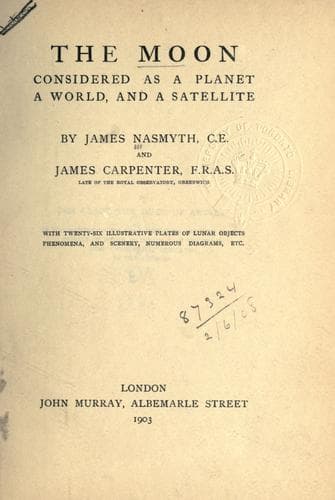
The Moon: considered as a planet, a world, and a satellite.Nasmyth, James
Science
The Moon: considered as a planet, a world, and a satellite.
Nasmyth, James
Moon
In turning our attention to these features, we are at the outset struck
with the paucity on the lunar surface of extensive mountain systems as
compared with its richness in respect of crateral formations; and a
field of speculation is opened by the recognition of the remarkable
contrast which the moon thus presents to the earth, where mountain
ranges are the rule, and craters like the lunar ones are decidedly
exceptional. Another conspicuous but inexplicable fact is that the most
important ranges upon the moon occur in the northern half of the visible
hemisphere, where the craters are fewest and the comparatively
featureless districts termed “seas” are found. The finest range is that
named after our Apennines and which is included in our illustrative
Plate, No. IX. It extends for about 450 miles and has been estimated to
contain upwards of 3000 peaks, one of which—Mount Huyghens—attains the
altitude of 18,000 feet. The Caucasus is another lunar range which
appears like a diverted northward extension of the Apennines, and,
although a far less imposing group than the last named, contains many
lofty peaks, one of which approaches the altitude assigned to Mount
Huyghens while several others range between 11,000 and 14,000 feet high.
Another considerable range is the Alps, situated between the Caucasus
and the crater Plato, and reproduced on Plate XIV. It contains some 700
peaked mountains and is remarkable for the immense valley, 80 miles long
and about five broad, that cuts it with seemingly artificial
straightness; and that, were it not for the flatness of its bottom,
might set one speculating upon the probability of some extraneous body
having rushed by the moon at an enormous velocity, gouging the surface
tangentially at this point and cutting a channel through the impeding
mass of mountains. There are other mountain ranges of less magnitude
than the foregoing; but those we have specified will suffice to
illustrate our suggestions concerning this class of features.
[Illustration: PLATE XV.
MERCATOR & CAMPANUS.]
We remark, too, that there is a prevailing tendency of the ranges just
mentioned to present their loftiest constituents in abrupt terminal
lines, facing nearly the same direction, the reverse of that towards
which they are carried by the moon’s rotation; and as they recede from
the high terminal line, the mountains gradually fall off in height, so
that in bulk the ranges present the “crag and tail” contour which
individual hills upon the earth so frequently exhibit.
Public-domain text, read in full here on John Shaqi.
Reviews
Reviews
No reviews yet
Be the first to share your thoughts on this work.
Elsewhere in the archive
Join the Discussion
Join the discussion
Sign in to leave a comment or review.
Sign InorCreate an account