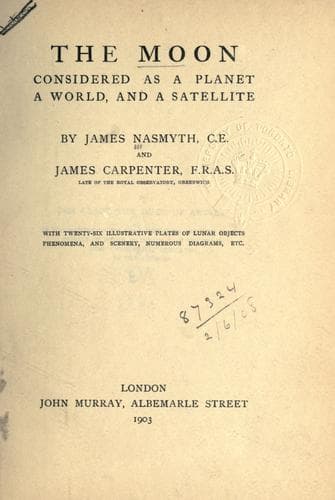
The Moon: considered as a planet, a world, and a satellite.Nasmyth, James
Science
The Moon: considered as a planet, a world, and a satellite.
Nasmyth, James
Moon
Reverting now to the moon, we remark that, if the foregoing explanation
of the isolated lunar peaks be tenable, it should hold equally for the
groups of them which we see in the lunar Apennines, Alps, Caucasus and
other ranges of like character. There occur in some places intermediate
groups which link the one to the other. Just above the crater
Archimedes, on Plate IX., for instance, we see several single peaks and
small clumps of them leading by successive multiple-peak examples to
what may be called chains of mountains like many that are included in
the contiguous Apennine system. And, in view of this connexion between
the single peaks and the mountain ranges formed of aggregations of such
peaks, it seems to us reasonable to conclude that the latter were formed
by the comparatively slow escape of lava through multitudinous openings
in a weak part of the moon’s crust, rather than to suppose that the
crust itself has been bodily upheaved and retained in its disturbed
position. The high peaks that many mountains in such a chain exhibit
accord better with the former than the latter explanation; for it is
difficult to imagine how such lofty eminences could be erected by an
upheaval, and we must remember that the moon has none of the denuding
elements which are at work upon the earth, weather-wearing its mountain
forms into sharpness and steepness.[12]
[Illustration: Fig. 40.
SMALL VOLCANIC MOUNTAIN AT THE END OF A STREET AT TENERIFFE.]
[Illustration: Fig. 41.]
And we have ground for believing the mountain-forming process on the
moon to have been a comparatively gentle one, in the fact that the
mountain systems appear in regions otherwise little disturbed, and where
craters, which have all the appearances of violent origin, are few and
far between. Evidently the mountain and crater-forming processes,
although both due to extrusive action, were in some measure different,
and it is reasonable to suppose that the difference was in degree of
intensity; so that while a violent ejection of volcanic material would
give rise to a crater, a more gradual discharge would pile up a
mountain. In this view craters are evidences of _eruptive_, and
mountains of comparatively gentle _exudative_ action.
Public-domain text, read in full here on John Shaqi.
Reviews
Reviews
No reviews yet
Be the first to share your thoughts on this work.
Elsewhere in the archive
Join the Discussion
Join the discussion
Sign in to leave a comment or review.
Sign InorCreate an account