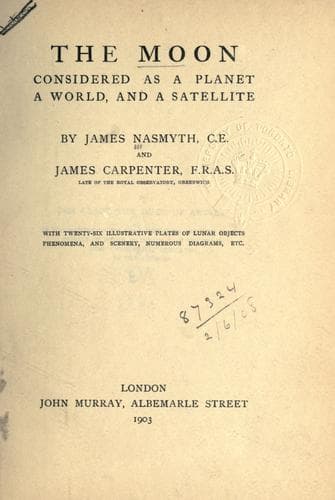
The Moon: considered as a planet, a world, and a satellite.Nasmyth, James
Science
The Moon: considered as a planet, a world, and a satellite.
Nasmyth, James
Moon
We can hardly speculate with any degree of safety upon the cause of this
varying intensity of volcanic discharge. We may ascribe it to variation
of _depth_ of the initial disturbing force, or to suddenness of its
action; or it may be that different degrees of fluidity of the lava have
had modifying effects; or on the other hand different qualities of the
crust-material; or yet again differences of period—the quieter
extrusions having occurred at a time when the volcanic forces were dying
down. There is an alliance between lunar craters and mountains that goes
far to show that there has been no radical difference in their origins.
For instance, as we have previously pointed out, craters in some cases
run in linear groups, as if in those cases they had been formed along a
line of disruption or of least resistance of the crust; and the mountain
chains have a corresponding linear arrangement. Then we see craters and
mountain chains disposed in what seem obviously the same arcs of
disturbance. Thus Copernicus (No. 147), Erastothenes (No. 168), and the
Apennines appear to belong to one continuous line of eruption; and it
requires no great stretch of imagination to suppose that the Caucasus,
Eudoxus (No. 208) and Aristotle (No. 209) form a continuation of the
same line. Then around the Mare Serenetatis we see mountainous ridges
and craters alternating one with the other as though the exuding action
there, normally sufficient to produce the ridges, had at some points
become forcible enough to produce a crater. Again, upon the very
mountain ranges themselves, as for instance among the Apennines, we find
small craters occurring. We see, too, that the great craters are in many
cases surrounded by radiating systems of ridges which almost assume
mountainous proportions, and which are doubtless exuded matter from
“starred” cracks, the centres of which are occupied by the craters. The
same kind of ridges here and there occur apart from craters (see for
instance Plate XVIII., below Aristarchus and Herodotus) and sometimes
they occur in the neighbourhood of extensive cracks, to which they also
seem allied. We must indeed regard a linear crack as the origin either
of a ridge (if the exudation is slight) or of a mountain chain (if the
exudation is more copious) or a string of craters (if the extrusion
rises to eruptive violence). But the subject of cracks is important
enough to be treated in a separate chapter.
Public-domain text, read in full here on John Shaqi.
Reviews
Reviews
No reviews yet
Be the first to share your thoughts on this work.
Elsewhere in the archive
Join the Discussion
Join the discussion
Sign in to leave a comment or review.
Sign InorCreate an account