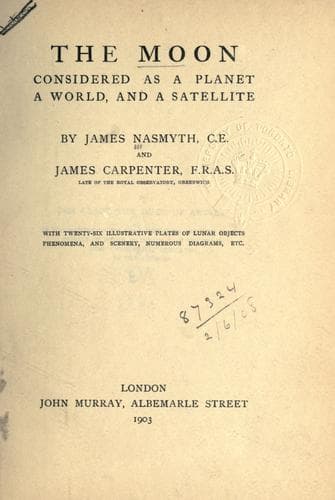
The Moon: considered as a planet, a world, and a satellite.Nasmyth, James
Science
The Moon: considered as a planet, a world, and a satellite.
Nasmyth, James
Moon
There are several prominent examples of these bright streak systems upon
the visible hemisphere of the moon; the focal craters of the most
conspicuous are Tycho, Copernicus, Kepler, Aristarchus, Menelaus, and
Proclus. Generally these focal craters have ramparts and interiors
distinguished by the same peculiar bright or highly reflective material
which shows itself with such remarkable brilliance, especially at full
moon: under other conditions of illumination they are not so strikingly
visible. At or nearly full moon the streaks are seen to traverse over
plains, mountains, craters, and all asperities; holding their way
totally disregardful of every object that happens to lay in their
course.
The most remarkable bright streak system is that diverging from the
great crater Tycho. The streaks that can be easily individualized in
this group number more than one hundred, while the courses of some of
them may be traced through upwards of six hundred miles from their
centre of divergence. Those around Copernicus, although less remarkable
in regard to their extent than those diverging from Tycho, are
nevertheless in many respects well deserving of careful examination:
they are so numerous as utterly to defy attempts to count them, while
their intricate reticulation renders any endeavour to delineate their
arrangement equally hopeless.
The fact that these bright streaks are invariably found diverging from a
crater, impressively indicates a close relationship or community of
origin between the two phenomena: they are obviously the result of one
and the same causative action. It is no less clear that the actuating
cause or prime agency must have been very deep-seated and of enormous
disruptive power to have operated over such vast areas as those through
which many of the streaks extend. With a view to illustrate
experimentally what we conceive to have been the nature of this
actuating cause, we have taken a glass globe and, having filled it with
water and hermetically sealed it, have plunged it into a warm bath: the
enclosed water, expanding at a greater rate than the glass, exerts a
disruptive force on the interior surface of the latter, the consequence
being that at the point of least resistance, the globe is rent by a vast
number of cracks diverging in every direction from the focus of
disruption. The result is such a strikingly similar counterpart of the
diverging bright streak systems which we see proceeding from Tycho and
the other lunar craters before referred to, that it is impossible to
resist the conclusion that the disruptive action which originated them
operated in the same manner as in the case of our experimental
illustration; the disruptive force in the case of the moon being that to
which we have frequently referred as due to the expansion which precedes
the solidification of molten substances of volcanic character.
Public-domain text, read in full here on John Shaqi.
Reviews
Reviews
No reviews yet
Be the first to share your thoughts on this work.
Elsewhere in the archive
Join the Discussion
Join the discussion
Sign in to leave a comment or review.
Sign InorCreate an account