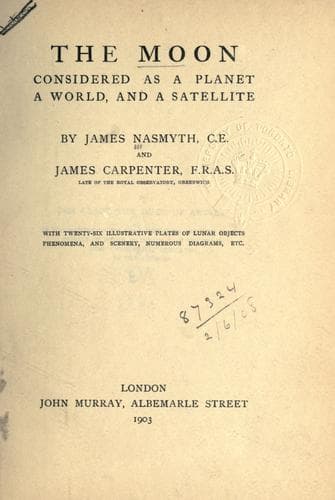
The Moon: considered as a planet, a world, and a satellite.Nasmyth, James
Science
The Moon: considered as a planet, a world, and a satellite.
Nasmyth, James
Moon
We alluded in Chap. III. to the phenomena of wrinkling or puckering as
productive of certain mountainous formations; and we pointed out the
striking similarity in character of configuration between a shrivelled
skin and a terrestrial mountain region. We do not perceive upon the moon
such a decided coincidence of appearances extending over any
considerable portion of her surface; but there are numerous limited
areas where we behold mountainous ridges which partake strongly of the
wrinkle character; and in some cases it is difficult to decide whether
the puckering agency or the exudative agency just discussed has produced
the ridges. The district bordering upon Aristarchus and Herodotus, above
referred to, is of this doubtful character; and a similar district is
that contiguous to Triesnecker (Plate XI.) There are, however, abundant
examples of less prominent lines of elevation, which may, with more
probability, be ascribed to a veritable wrinkling or puckering action;
they are found over nearly the whole lunar surface, some of them
standing out in considerable relief, and some merely showing gentle
lines of elevation, or giving the surface an undulating appearance. A
close examination of our picture-map (Plate IV.) will reveal very
numerous examples, especially in the south-east (right-hand-upper)
quadrant. Some of these lines of tumescence are so slightly prominent
that we may suppose them to have been caused by the action indicated by
Fig. 6 (p. 28), while others, from their greater boldness, appear to
indicate a formative action analogous to that represented by Fig. 9 (p.
29).
[Illustration: IDEAL SKETCH OF PICO AS IT WOULD PROBABLY APPEAR IF
SEEN BY A SPECTATOR LOCATED ON THE MOON.]
[Illustration: PLATE XVII.
WARGENTIN.]
CHAPTER XI.
CRACKS AND RADIATING STREAKS.
We have hitherto confined our attention to those reactions of the moon’s
molten interior upon its exterior which have been accompanied by
considerable extrusions of sub-surface material in its molten or
semi-solid condition. We now pass to the consideration of some phenomena
resulting in part from that reaction and in part from other effects of
cooling, which have been accompanied by comparatively little ejection or
upflow of molten matter, and in some cases by none at all. Of such the
most conspicuous examples are those bright streaks that are seen, under
certain conditions of illumination, to radiate in various directions
from single craters, and some of the individual radial branches of which
extend from four to seven hundred miles in a great arc on the moon’s
surface.
Public-domain text, read in full here on John Shaqi.
Reviews
Reviews
No reviews yet
Be the first to share your thoughts on this work.
Elsewhere in the archive
Join the Discussion
Join the discussion
Sign in to leave a comment or review.
Sign InorCreate an account