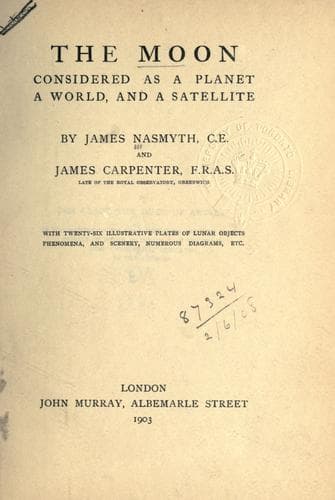
The Moon: considered as a planet, a world, and a satellite.Nasmyth, James
Science
The Moon: considered as a planet, a world, and a satellite.
Nasmyth, James
Moon
confluence of the lava issuing from which would naturally yield the
appearance of one streak of great width. Some of those diverging from
Tycho are of this class; many other examples might be cited, among which
we may name the wide streaks proceeding from the crater Menelaus and
also those from Proclus. Some of these occupy widths upwards of 25
miles—amply sufficient to admit of many concurrent cracks with confluent
lava outflows.
We are disposed to consider as related to the fore-mentioned radiating
streaks, the numerous, we may say the multitudinous, long and narrow
chasms that have been sometimes called “canals” or “rills,” but which
are so obviously _cracks_ or chasms, that it is desirable that this name
should be applied to them rather than one which may mislead by implying
an aqueous theory of formation. These cracks, singly and in groups, are
found in great numbers in many parts of the moon’s surface. As a few of
the more conspicuous examples which our plates exhibit we may refer to
the remarkable group west of Treisnecker (Plate XI.), the principal
members of which converge to or cross at a small crater, and thus point
to a continuity of causation therewith analogous to the evident relation
between the bright streaks and their focal craters. Less remarkable, but
no less interesting, are those individual examples that appear in the
region north of (below) the Apennines (Plate IX.), and some of which by
their parallelism of direction with the mountain-chain appear to point
to a causative relation also. There is one long specimen, and several
shorter in the immediate neighbourhood of Mercator and Campanus (Plate
XV.); and another curious system of them, presenting suggestive
contortions, occurs in connection with the mountains Aristarchus and
Herodotus (Plate XVIII.). Others, again, appear to be identified with
the radial excrescences about Copernicus (Plate VIII.). Capuanus,
Agrippa, and Gassendi, among other craters, have more or less notable
cracks in their vicinities.
Public-domain text, read in full here on John Shaqi.
Reviews
Reviews
No reviews yet
Be the first to share your thoughts on this work.
Elsewhere in the archive
Join the Discussion
Join the discussion
Sign in to leave a comment or review.
Sign InorCreate an account