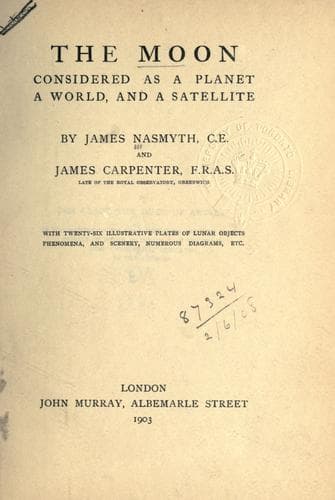
The Moon: considered as a planet, a world, and a satellite.Nasmyth, James
Science
The Moon: considered as a planet, a world, and a satellite.
Nasmyth, James
Moon
Some of these chasms are conspicuous enough to be seen with moderate
telescopic means, and from this maximum degree of visibility there are
all grades downwards to those that require the highest optical powers
and the best circumstances for their detection. The earlier
selenographers detected but a few of them. Schroeter noted only 11;
Lohrman recorded 75 more; Beer and Maedler added 55 to the list, while
Schmidt of Athens raised the known number to 425, of which he has
published a descriptive catalogue. We take it that this increase of
successive discoveries has been due to the progressive perfection of
telescopes, or, perhaps, to increased education, so to speak, of the
eye, since Schmidt’s telescope is a much smaller instrument than that
used by Beer and Maedler, and is regarded by its owner as an inferior
one for its size. We doubt not that there are hundreds more of these
cracks which more perfect instruments and still sharper eyes will bring
to knowledge in the future.
While these chasms have all lengths from 150 miles (which is about the
extent of those near Treisnecker) down to a few miles, they appear to
have a less variable breadth, since we do not find many that at their
maximum openings exceed two miles across; about a mile or less is their
usual width throughout the greater part of their length, and generally
they taper off to invisibility at their extremities, where they do not
encounter and terminate at a crater or other asperity, which is,
however, sometimes the case. Of their depth we can form no precise
estimate, though from the sharpness of their edges we may conclude that
their sides approach perpendicularity, and, therefore, that their depth
is very great; we have elsewhere suggested ten miles as a possible
profundity. In a few cases, and under very favourable circumstances, we
have observed their generally black interiors to be interrupted here and
there with bright spots suggestive of fragments from the sides of the
cracks having fallen into the opening.
Public-domain text, read in full here on John Shaqi.
Reviews
Reviews
No reviews yet
Be the first to share your thoughts on this work.
Elsewhere in the archive
Join the Discussion
Join the discussion
Sign in to leave a comment or review.
Sign InorCreate an account