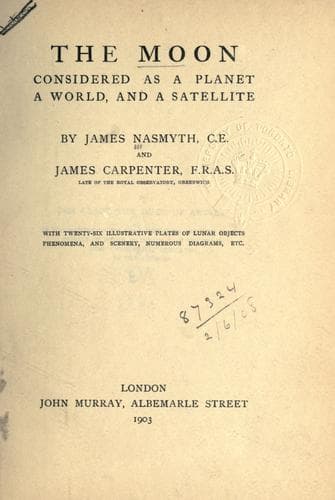
The Moon: considered as a planet, a world, and a satellite.Nasmyth, James
Science
The Moon: considered as a planet, a world, and a satellite.
Nasmyth, James
Moon
We have suggested shrinkage as a possible explanation of some cracks. It
could hardly have been the direct cause of those compound ones which are
distinguished by focal craters, though it may have been a co-operative
cause, since the contracting tendency of any area of the crust, by so to
speak weakening it, may have virtually increased the strength of an
upheaving force and thus have aided and localized its action. We see,
however, no reason why the inevitable ultimate contraction which must
have attended the cooling of the moon’s crust, even when all internal
reactions upon it had ceased, should not have created a class of cracks
without accompanying craters, while it would doubtless have a tendency
to increase the length and width of those already existing from any
other cause. Some of the more minute clefts, which presumably exist in
greater numbers than we yet know of, may doubtless be ascribed to this
effect of cooling contraction. In this view we should have to regard
such cracks as the latest of all lunar features. Whether the agency that
produced them is still at work—whether the cracks are on the increase—is
a question impossible of solution: for reasons to be presently adduced,
we incline to believe that all cosmical heat passed from the moon, and
therefore that it arrived at its present, and apparently final,
condition ages upon ages ago.
Besides the ridges spoken of on p. 140, and regarded as cracks up
through which matter has been extruded, there are numerous ridges of
greater or less extent, which we conceive are of the nature of wrinkles,
and have been produced by tangential compression due to the collapse of
the moon’s crust upon the shrunken interior, as explained and
illustrated in Chap. III. The distinguishing feature of the two classes
of phenomena we consider to be the presence of a serrated summit in
those of the extruded class, while those produced by “wrinkling” action
have their summits comparatively free from serration or marked
irregularity.
CHAPTER XII.
COLOUR AND BRIGHTNESS OF LUNAR DETAILS: CHRONOLOGY OF FORMATIONS, AND
FINALITY OF EXISTING FEATURES.
Public-domain text, read in full here on John Shaqi.
Reviews
Reviews
No reviews yet
Be the first to share your thoughts on this work.
Elsewhere in the archive
Join the Discussion
Join the discussion
Sign in to leave a comment or review.
Sign InorCreate an account