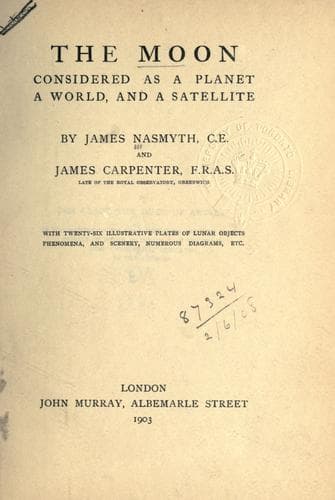
The Moon: considered as a planet, a world, and a satellite.Nasmyth, James
Science
The Moon: considered as a planet, a world, and a satellite.
Nasmyth, James
Moon
Speaking generally, the details of the lunar surface seem to us to be
devoid of colour. To the naked eye of ordinary sensitiveness the moon
appears to possess a silvery whiteness: more critical judges of colour
would describe it as presenting a yellowish tinge. Sir John Herschel,
during his sojourn at the Cape of Good Hope, had frequent opportunities
of comparing the moon’s lustre with that of the weathered sandstone
surface of Table Mountain, when the moon was setting behind it, and both
were illuminated under the same direction of sunlight; and he remarked
that the moon was at such times “scarcely distinguishable from the rock
in apparent contact with it.” Although his observations had reference
chiefly to brightness, it can hardly be doubted that similarity of
colour is also implied; for any difference in the tint of the two
objects would have precluded the use of the words “scarcely
distinguishable;” a difference of colour interfering with a comparison
of lustre in such an observation, though it must be remembered that he
observed through a dense stratum of atmosphere. Viewed in the telescope,
the same general yellowish-white colour prevails over all the moon, with
a few exceptions offered by the so-called seas. The _Mare Crisium_,
_Mare Serenetatis_, and _Mare Humorum_ have somewhat of a greenish tint;
the _Palus Somnii_ and the circular area of Lichtenberg incline to
ruddiness. These tints are, however, extremely faint, and it has been
suggested by Arago that they may be mere effects of contrast rather than
actual colouration of the surface material. This, however, can hardly be
the case, since all the “seas” are not alike affected; those that are
slightly coloured are, as we have said, some green and some red, and
contrast could scarcely produce such variations. The supposition of
vegetation covering these great flats and giving them a local colour is
in our view still more untenable, in the face of the arguments that we
shall presently adduce against the possibility of vegetable life
existing upon the moon.
It appears to us more rational to consider the tints due to actual
colour of the material (presumably lava or some once fluid mineral
substance) that has covered these areas; and it may well be conceived
that the variety of tint is due to different characters of material, or
even various conditions of the same material coming from different
depths below the lunar surface; and we may reasonably suppose that the
same variously-coloured substances occur in the rougher regions of the
lunar surface, but that they exist there in patches too small to be
recognized by us, or are “put out” by the brightness to which polyhedral
reflexion gives rise.
Public-domain text, read in full here on John Shaqi.
Reviews
Reviews
No reviews yet
Be the first to share your thoughts on this work.
Elsewhere in the archive
Join the Discussion
Join the discussion
Sign in to leave a comment or review.
Sign InorCreate an account