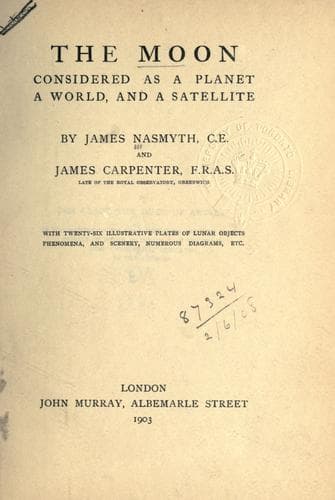
The Moon: considered as a planet, a world, and a satellite.Nasmyth, James
Science
The Moon: considered as a planet, a world, and a satellite.
Nasmyth, James
Moon
The foregoing remarks naturally lead us to the question whether changes
are still going on upon the surface of our satellite: whether there is
still left in it a spark of its volcanic activity, or whether that
activity has become totally extinct. We shall consider this question
from the observational and theoretical point of view. First as regards
observations. This much may be affirmed indisputably—that no object or
detail visible to the earliest selenographers (whose period may be dated
200 years back) has altered from the date of their maps to the present.
When we pass from the bolder features to the more minute details we find
ourselves at a loss for materials for forming an inference; the only map
pretending to accuracy even of the larger among small objects being that
of Beer and Maedler, which, truly admirable as it is, is not very safely
to be relied upon for settling any question of alleged change, on
account of the conventional system adopted for exhibiting the forms of
objects, every object being mapped rather than drawn, and shown as it
never is or can be presented to view on the moon itself. This difficulty
would present itself if a question of change were ever raised upon the
evidence of Beer and Maedler’s map: it may indeed have prevented such a
question being raised, for certainly no one has hitherto been bold
enough to assert that any portion or detail of the map fails to
represent the actual state of the moon at the present time.
In default of published maps, we are thrown for evidence on this
question upon observations and recollections of individual observers
whose familiarity with the lunar details extends over lengthy periods.
Speaking for ourselves, and upon the strength of close scrutinies
continued with assiduity through the past thirty years, we may say that
we have never had the suspicion suggested to our eye of any actual
change whatever having taken place in any feature or minute detail of
the lunar surface; and our scrutinies have throughout been made with
ample optical means, mostly with a 20-inch reflector. This experience
has made us not unnaturally in some slight degree sceptical concerning
the changes alleged to have been detected by others. Those asserted by
Schroeter and Gruithuisen were long ago rejected by Beer and Maedler,
who explained them, where the accuracy of the observer was not
questioned, by variations of illumination, a cause of illusory change
which is not always sufficiently taken into account. A notable instance
of this deception occurred a few years ago in the case of the minute
bright crater _Linné_, which was for a considerable period declared,
upon the strength of observations of very promiscuous character, to be
varying in form and dimensions almost daily, but the alleged constant
changes of which have since been tacitly regarded as due to varying
circumstances of illumination induced by combinations of libratory
effects with the ordinary changes depending upon the direction of the
Public-domain text, read in full here on John Shaqi.
Reviews
Reviews
No reviews yet
Be the first to share your thoughts on this work.
Elsewhere in the archive
Join the Discussion
Join the discussion
Sign in to leave a comment or review.
Sign InorCreate an account