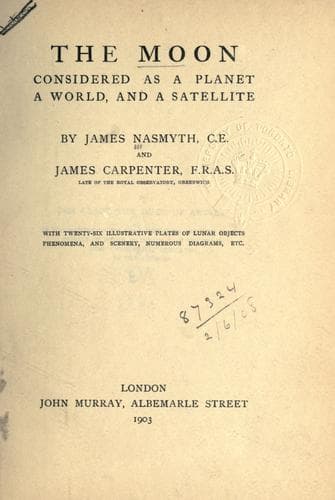
The Moon: considered as a planet, a world, and a satellite.Nasmyth, James
Science
The Moon: considered as a planet, a world, and a satellite.
Nasmyth, James
Moon
largest were produced in the throes of its early violence, and that the
smallest are the results of expiring efforts possibly impeded through
the deep-seatedness of the ejective source.
Another general fact of this chronological order is that the mountain
chains are never seen to intrude upon formations of the crater order. We
do not anywhere find that a mountain chain runs absolutely into or
through a crater; but, on the other hand, we do find that craters have
formed on mountain chains. This leads unmistakably to the inference that
the craters were not formed _before_ their allied mountain chains; and
we might assume therefore that the mountains generally are the older
formations, but that there is nothing to prove that the two classes of
features, where they intermingle, as in the Apennines and Caucasus, were
not erupted cotemporaneously.
[Illustration: PLATE XX.
OVERLAPPING CRATERS.]
Upon the assumption that the latest ejected or extruded matter is that
which is brightest, we should place the bright streaks among the more
recent features. Be this as it may, it is tolerably certain that the
cracks, whose apparently close relation to the radiating streaks we have
endeavoured to point out, are relatively of a very late formative
period. We are indeed disposed to consider them as the most recent
features of all: the evidence in support of this consideration being the
fact that they are sometimes found intersecting small craters that, from
the way in which they are cut through by the cracks, must have been _in
situ_ before the cracking agency came into operation. It is in
accordance with our hypothesis of the moon’s transition from a fluid to
a solid body to consider that a cracking of the surface would be the
latest of all the phenomena produced by contraction in final cooling.
Public-domain text, read in full here on John Shaqi.
Reviews
Reviews
No reviews yet
Be the first to share your thoughts on this work.
Elsewhere in the archive
Join the Discussion
Join the discussion
Sign in to leave a comment or review.
Sign InorCreate an account