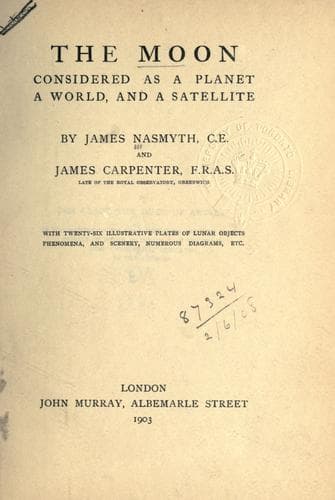
The Moon: considered as a planet, a world, and a satellite.Nasmyth, James
Science
The Moon: considered as a planet, a world, and a satellite.
Nasmyth, James
Moon
The theoretical view of the question, which we have now to consider, has
led us, however, to the strong belief that no vestige of its former
volcanic activity lingers in the moon—that it assumed its final
condition an inconceivable number of ages ago, and that the high
interest which would attach to the close scrutiny of our satellite if it
_were_ still the theatre of volcanic reactions cannot be hoped for. If
it be just and allowable to assume that the earth and the moon were
condensed into planetary form at nearly the same epoch (and the only
rational scheme of cosmogony justifies the assumption) then we may
institute a comparison between the condition of the two bodies as
respects their volcanic age, using the one as a basis for inference
concerning the state of the other. We have reason to believe that the
earth’s crust has nearly assumed its final state so far as volcanic
reactions of its interior upon its exterior are concerned: we may affirm
that within the historical period no igneous convulsions of any
considerable magnitude have occurred; and we may consider that the
volcanoes now active over the surface of the globe represent the last
expiring efforts of its eruptive force. Now in the earth we perceive
several conditions wherefrom we may infer that it parted with its
cosmical heat (and therefore with its prime source of volcanic agency)
at a rate which will appear relatively very slow when we come to compare
the like conditions in the moon. We may, we think, take for granted that
the surface of a planetary body generally determines its _heat
dispersing_ power, while its volume determines its _heat retaining_
power. Given two spherical bodies of similar material but of unequal
magnitude and originally possessing the same degree of heat, the smaller
body will cool more rapidly than the larger, by reason of the greater
proportion which the surface of the smaller sphere bears to its volume
than that of the larger sphere to its volume—this proportion depending
upon the geometrical ratio which the surfaces of spheres bear to their
volumes, the contents of spheres being as the _cubes_ and the surfaces
as the _squares_ of their diameters. The volume of the earth is 49 times
as great as that of the moon, but its surface is only 13 times as great;
there is consequently in the earth a power of retaining its cosmical
heat nearly four times as great as in the case of the moon; in other
words, the moon and earth being supposed at one time to have had an
equally high temperature, the moon would cool down to a given low
temperature in about one fourth the time that the earth would require to
cool to the same temperature. But the earth’s cosmical heat has without
doubt been considerably conserved by its vaporous atmosphere, and still
more by the ocean in its antecedent vaporous form. Yet notwithstanding
all this, the earth’s surface has nearly assumed its final condition so
far as volcanic agencies are concerned: it has so far cooled as to be
Public-domain text, read in full here on John Shaqi.
Reviews
Reviews
No reviews yet
Be the first to share your thoughts on this work.
Elsewhere in the archive
Join the Discussion
Join the discussion
Sign in to leave a comment or review.
Sign InorCreate an account