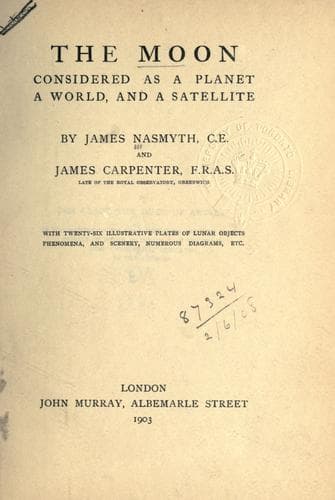
The Moon: considered as a planet, a world, and a satellite.Nasmyth, James
Science
The Moon: considered as a planet, a world, and a satellite.
Nasmyth, James
Moon
subject to no considerable distortions or disruptions of its surface.
What then must be the state of the moon, which, from its small volume
and large proportionate area, parted with its heat at the above
comparatively rapid rate? The matter of the moon is, too, less dense
than the earth, and hence doubtless from this cause disposed to more
rapid cooling; and it has no atmosphere or vaporous envelope to retard
its radiating heat. We are driven thus to the conclusion that the moon’s
loss of cosmical heat must have been so rapid as to have allowed its
surface to assume its final conformation ages on ages ago, and hence
that it is unreasonable and hopeless to look for evidence of change of
any volcanic character still going on.
We conceive it possible, however, that minute changes of a non-volcanic
character may be proceeding in the moon, arising from the violent
alternations of temperature to which the surface is exposed during a
lunar day and night. The sun, as we know, pours down its heat
unintermittingly for a period of fully 300 hours upon the lunar surface,
and the experimental investigations of Lord Rosse, essentially confirmed
by those of the French observer, Marie Davy, show that under this
powerful insolation the surface becomes heated to a degree which is
estimated at about 500° of Fahrenheit’s scale, the fusing point of tin
or bismuth. This heat, however, is entirely radiated away during the
equally long lunar night, and, as Sir John Herschel surmised, the
surface probably cools down again to a temperature as low as that of
interstellar space: this has been assumed as representing the absolute
zero of temperature, which has been calculated from experiments to be
250° below the zero of Fahrenheit’s scale. Now such a severe range of
heat and cold can hardly be without effect upon some of the component
materials of the lunar surface.[15] If there be any such materials as
the vitreous lavas that are found about our volcanoes, such as obsidian
for instance, they are doubtless cracked and shivered by these extreme
transitions of temperature; and this comparatively rapid succession of
changes continued through long ages would, we may suppose, result in a
disintegration of some parts of the surface and at length somewhat
modify the selenographic contour. It is, however, possible that the
surface matter is mainly composed of more crystalline and porous lavas,
and these might withstand the fierce extremes like the “fire-brick” of
mundane manufacture, to which in molecular structure they may be
considered comparable. Lavas as a rule are (upon the earth) of this
unvitreous nature, and if they are of like constitution on the moon,
there will be little reason to suspect changes from the cause we are
considering. Where, however, the material, whatever its nature, is piled
in more or less detached masses, there will doubtless be a grating and
fracturing at the points of contact of one mass with another, produced
Public-domain text, read in full here on John Shaqi.
Reviews
Reviews
No reviews yet
Be the first to share your thoughts on this work.
Elsewhere in the archive
Join the Discussion
Join the discussion
Sign in to leave a comment or review.
Sign InorCreate an account