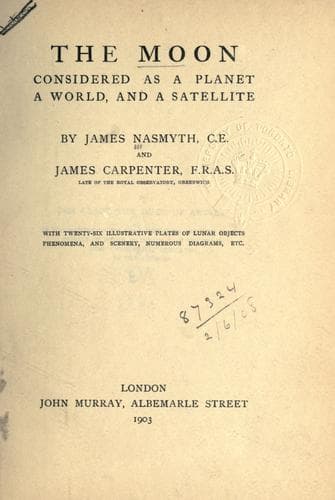
The Moon: considered as a planet, a world, and a satellite.Nasmyth, James
Science
The Moon: considered as a planet, a world, and a satellite.
Nasmyth, James
Moon
We well know what are the requisite conditions of life on the earth; and
we can go no further for grounds of inference; for if we were to start
by assuming forms of life capable of existence under conditions widely
and essentially different from those pertaining to our planet, there
would be no need for discussing our subject further: we could revel in
conjectures, without a thought as to their extravagance. The only
legitimate phase of the question we can entertain is this:—can there be
on the moon any kind of living things analogous to any kind of living
things upon the earth? And this question, we think, admits only of a
negative answer. The lowest forms of vitality cannot exist without air,
moisture, and a moderate range of temperature. It may be true, as recent
experiments seem to show, that organic germs will retain their vitality
without either of the first, and with exposure to intense cold and to a
considerable degree of heat; and it is conceivable that the mere germs
of life may be present on the moon.[16] But this is not the case with
living organisms themselves. We have, in Chapter V., specially devoted
to the subject, cited the evidence from which we know that there can be
at the most, no more air on the moon than is left in the receiver of an
air-pump after the ordinary process of exhaustion. And with regard to
moisture, it could not exist in any but the vaporous state, and we know
that no appreciable amount of vapour can be discovered by any
observation (and some of them are crucial enough) that we are capable of
making. We may suppose it just within the verge of possibility that some
low forms of vegetation might exist upon the moon with a paucity of air
and moisture such as would be beyond even our most severe powers of
detection: but granting even this, we are met by the temperature
difficulty; for it is inconceivable that any plant-life could survive
exposure first to a degree of cold vastly surpassing that of our arctic
regions, and then in a short time (14 days) to a degree of heat capable
of melting the more fusible metals—the total range being equal, as we
have elsewhere shown, to perhaps 600 or 700 degrees of our thermometric
scale.
The higher forms of vegetation could not reasonably be expected to exist
under conditions which the lower forms could not survive. And as regards
the possibility of the existence of animal life in any form or condition
on the lunar surface, the reasons we have adduced in reference to the
non-existence of vegetable life bear still more strongly against the
possibility of the existence of the former. We know of no animal that
could live in what may be considered a vacuum and under such thermal
conditions as we have indicated.
[Illustration: PLATE XXI.
NORMAL LUNAR CRATER.]
Public-domain text, read in full here on John Shaqi.
Reviews
Reviews
No reviews yet
Be the first to share your thoughts on this work.
Elsewhere in the archive
Join the Discussion
Join the discussion
Sign in to leave a comment or review.
Sign InorCreate an account