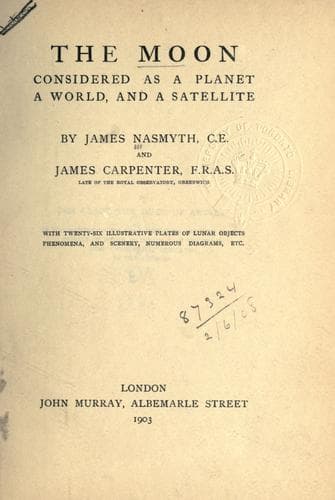
The Moon: considered as a planet, a world, and a satellite.Nasmyth, James
Science
The Moon: considered as a planet, a world, and a satellite.
Nasmyth, James
Moon
As to man, aëronautic experience teaches us that human life is
endangered when the atmosphere is still sufficiently dense to support 12
inches of mercury in the barometer tube; what then would be his
condition in a medium only sufficiently dense to sustain one-tenth of an
inch of the barometric column? We have evidence from the most delicate
tests that no atmosphere or vapour approaching even this degree of
attenuation exists around the moon’s surface.
Taking all these adverse conditions into consideration we are in every
respect justified in concluding that there is no possibility of animal
or vegetable life existing on the moon, and that our satellite must
therefore be regarded as a barren world.
* * * * * * * *
After this disquisition upon lunar uninhabitability it may appear
somewhat inconsistent for us to attempt a description of the scenery of
the moon and some other effects that would be visible to a spectator,
and of which he would be otherwise sensible, during a day and a night
upon her surface. But we can offer the sufficient apology that an
imaginary sojourn of one complete lunar day and night upon the moon
affords an opportunity of marshalling before our readers some phenomena
that are proper to be noticed in a work of this character, and that have
necessarily been passed over in the series of chapters on consecutive
and special points that have gone before. It may be urged that, in
depicting the moon from such a standpoint as that now to be taken, we
are describing scenes that never have been such in the literal sense of
the word, since no eye has ever beheld them. Still we have this
justification—that we are invoking the conception of things that
actually exist; and that we are not, like some imaginary voyagers to the
moon, indulging in mere flights of fancy. Although it is impossible for
a habitant of this earth fully to realise existence upon the moon, it is
yet possible, indeed almost inevitable, for a thoughtful
telescopist—watching the moon night after night, observing the sun rise
upon a lunar scene, and noting the course of effects that follow till it
sets—it is almost inevitable, we say, for such an observer to identify
himself so far with the object of his scrutiny, as sometimes to become
in thought a lunar being. Seated in silence and in solitude at a
powerful telescope, abstracted from terrestrial influences, and gazing
upon the revealed details of some strikingly characteristic region of
the moon, it requires but a small effort of the imagination to suppose
one’s self actually upon the lunar globe, viewing some distant landscape
thereupon; and under these circumstances there is an irresistible
tendency in the mind to pass beyond the actually _visible_, and to fill
in with what it knows must exist those accessory features and phenomena
that are only hidden from us by distance and by our peculiar point of
view. Where the material eye is baffled, the clairvoyance of reason and
Public-domain text, read in full here on John Shaqi.
Reviews
Reviews
No reviews yet
Be the first to share your thoughts on this work.
Elsewhere in the archive
Join the Discussion
Join the discussion
Sign in to leave a comment or review.
Sign InorCreate an account