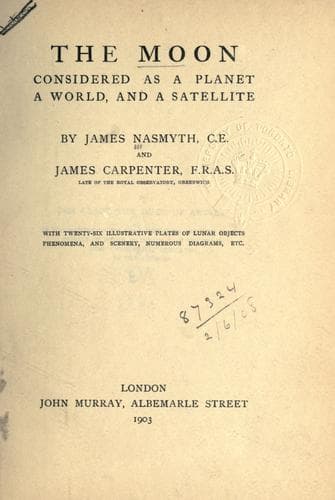
The Moon: considered as a planet, a world, and a satellite.Nasmyth, James
Science
The Moon: considered as a planet, a world, and a satellite.
Nasmyth, James
Moon
upon rare occasions is the lunar scenery suffused with coloured
illumination, and these are when, as we shall presently have to
describe, the solar rays reach the moon after traversing the earth’s
atmosphere during an eclipse of the sun.
This atmosphere of ours is the most influential element in beautifying
our terrestrial scenery, and the absence of such an appendage from the
moon is the great modifying cause that affects lunar scenery as compared
with that of the earth. We are accustomed to the sun with its dazzling
brightness—overpowering though it be—subdued and softened by our
vaporous screen. Upon the moon there is no such modification. The sun’s
intrinsic brilliancy is undiminished, its apparent distance is
shortened, and it gleams out in fierce splendour only to be realised,
and then imperfectly, by the conception of a gigantic electric light a
few feet from the eye. And the brightness is rendered the more striking
by the blackness of the surrounding sky. Since there is no atmosphere
there can be no sky-light, for there is nothing above the lunar world to
diffuse the solar beams; not a trace of that moisture which even in our
tropical skies scatters some of the sun’s light and gives a certain
degree of opacity or blueness, deep though it be, to the heavens by day.
Upon the moon, with no light-diffusing vapour, the sky must be as dark
or even darker than that with which we are familiar upon the finest of
moonless nights. And this blackness prevails in the full blaze of the
lunar noon-day sun. If the eye (upon the moon) could bear to gaze upon
the solar orb (which would be less possible than upon earth) or could it
be screened from the direct beams, as doubtless it could by intervening
objects, it would perceive the nebulous and other appendages which we
know as the corona, the zodiacal light, and the red solar protuberances:
or if these appendages could not be viewed with the sun above the
horizon they would certainly be seen in glorious perfection when the
luminary was about to rise or immediately after it had set.
Public-domain text, read in full here on John Shaqi.
Reviews
Reviews
No reviews yet
Be the first to share your thoughts on this work.
Elsewhere in the archive
Join the Discussion
Join the discussion
Sign in to leave a comment or review.
Sign InorCreate an account