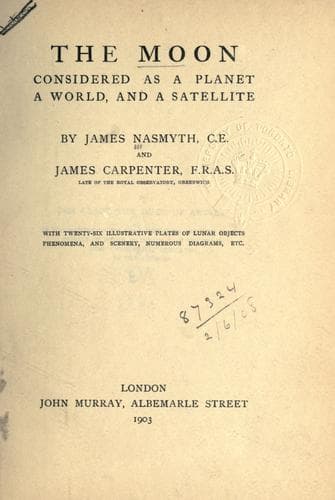
The Moon: considered as a planet, a world, and a satellite.Nasmyth, James
Science
The Moon: considered as a planet, a world, and a satellite.
Nasmyth, James
Moon
analogy comes to its aid.
Let us then endeavour to realize the strange consequences which the
position and conditions of the moon produce upon the aspect of a lunar
landscape in the course of a lunar day and night.
The moon’s day is a long one. From the time that the sun rises upon a
scene[17] till it sets, a period of 304 hours elapses, and of course
double this interval passes between one sunrise and the next. The
consequences of this slow march of the sun begin to show themselves from
the instant that he rises above the lunar horizon. Dawn, as we have it
on earth, can have no counterpart upon the moon. No atmosphere is there
to reflect the solar beams while the luminary is yet out of actual
sight, and only the glimmer of the zodiacal light heralds the approach
of day. From the black horizon the sun suddenly darts his bright
untempered beams upon the mountain tops, crowning them with dazzling
brilliance while their flanks and valleys are yet in utter darkness.
There is no blending of the night into day. And yet there is a growth of
illumination that in its early stages may be called a twilight, and
which is caused by the slow rise of the sun. Upon the earth, in central
latitudes, the average time occupied by the sun in rising, from the
first glint of his upper edge till the whole disc is in sight, is but
two minutes and a quarter. Upon the moon, however, this time is extended
to a few minutes short of an hour, and, therefore, during the first few
minutes a dim light will be shed by the small visible chord of the solar
disc, and this will give a proportionately modified degree of
illumination upon the prominent portion of the landscape, and impart to
it something of the weird aspect which so strikes an observer of a total
solar eclipse on earth when the scene is lit by the thin crescent of the
re-appearing sun. This impaired illumination constitutes the only dawn
that a lunar spectator could behold. And it must be of short duration;
for when, in the course of half an hour, the solar disc has risen half
into view the lighting would no doubt appear nearly as bright to the eye
as when the entire disc of the sun is above the horizon. In this lunar
sunrise, however, there is none of that gilding and glowing which makes
the phenomenon on earth so gorgeous. Those crimson sky-tints with which
we are familiar are due to the absorption of certain of the polychromous
rays of light by our atmosphere. The blue and violet components of the
solar beams are intercepted by our envelope of vapour, and only the red
portions are free to pass; while on the moon, as there is no atmosphere,
this selective absorption does not occur. If it did, an observer gazing
from the earth upon the regions of the moon upon which the sun is just
rising would see the surface tinted with rosy light. This, however, is
not the case; the faintest lunar features just catching the sun are seen
simply under white light diluted to a low degree of brightness. Only
Public-domain text, read in full here on John Shaqi.
Reviews
Reviews
No reviews yet
Be the first to share your thoughts on this work.
Elsewhere in the archive
Join the Discussion
Join the discussion
Sign in to leave a comment or review.
Sign InorCreate an account