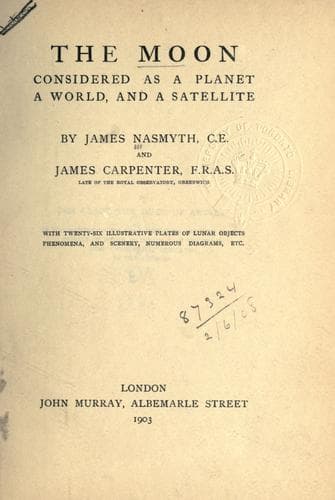
The Moon: considered as a planet, a world, and a satellite.Nasmyth, James
Science
The Moon: considered as a planet, a world, and a satellite.
Nasmyth, James
Moon
One planet, however, that adorns the sky of the lunar hemisphere which
is turned towards us deserves special mention from the conspicuous and
highly interesting appearance it must present. We allude to the earth.
To nearly one-half of the moon (that which we never see) this imposing
object can never be visible; but to the half that faces us the
terrestrial planet must appear almost fixed in the sky. A lunar
spectator in (what is to us) the centre of the disc, or about the region
north of the lunar mountains Ptolemy and Hipparchus, would have the
earth in his zenith. From regions upon the moon a little out of what is
to us the centre, a spectator would see the earth a little declining
from the zenith, and this declination would increase as the regions
corresponding to the (to us) apparent edge of the moon were approached,
till at the actual edge it would be seen only upon the horizon. From the
phenomena of libration (explained in Chap. VI.) the earth would appear
from nearly all parts of the lunar hemisphere to which it is visible at
all to describe a small circle in the sky. To an observer, however, upon
the (to us) marginal regions of the lunar globe, it would appear only
during a portion of the lunar day—being visible in fact only in that
part of its small circular path which happened to lie above the
observer’s horizon: in some regions only a portion of the terrestrial
disc would make its brief appearance. From the lunar hemisphere beyond
this marginal line the earth can never be seen at all.
The lunar spectator whose situation enabled him to view the earth would
see it as a moon; and a glorious moon indeed it must be. Its diameter
would be four times as great as that of the moon itself as seen by us,
and the area of its full disc 13 times as great. It would be seen to
pass through its phases, just as does our satellite, once in a lunar day
or a terrestrial month, and during that cycle of phases, since 29 of our
days would be occupied by it, the axial rotation would bring all the
features of its surface configuration into view so many times in
succession. But the greatest beauty of this noble moon would be seen
during the lunar night, in considering which we shall again allude to
it; for when it is full-moon to the earth it is new-earth to the moon.
At lunar midnight this globe of ours is fully illuminated; as morning
nears, the earth-moon wanes, its disc slowly passing through the gibbous
phases until at sunrise it would be just half-illuminated. During the
long forenoon it assumes a crescent which narrows and narrows till at
midday the sun is in line with the earth and the latter is invisible,
save perhaps by a thin line of light marking its upper or lower edge,
accordingly as the sun is apparently above or below it. In the lunar
afternoon an illuminated crescent appears upon the opposite side of the
terrestrial globe, and this widens and widens till it becomes a half
disc by lunar sunset and a full disc by lunar midnight.
Public-domain text, read in full here on John Shaqi.
Reviews
Reviews
No reviews yet
Be the first to share your thoughts on this work.
Elsewhere in the archive
Join the Discussion
Join the discussion
Sign in to leave a comment or review.
Sign InorCreate an account