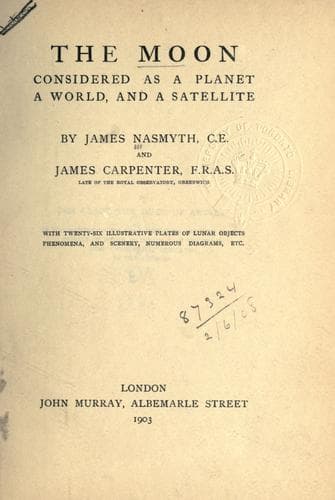
The Moon: considered as a planet, a world, and a satellite.Nasmyth, James
Science
The Moon: considered as a planet, a world, and a satellite.
Nasmyth, James
Moon
The sun in his daily course passes at various distances, sometimes above
and sometimes below, the nearly stationary earth. Obviously it will at
times pass actually behind it, and then the lunar spectator would behold
the sublime spectacle of a total solar eclipse, and that under
circumstances which render the phenomenon far more imposing than its
counterpart can appear from the earth; for whereas, when we see the moon
eclipse the sun, the nearly similar (apparent) diameters of the two
bodies renders the duration of totality extremely short—at most 7
minutes—a lunar spectator, the earth appearing to him four times the
diameter of the sun, and he and the earth being relatively stationary,
would enjoy a view of the totality extending over several hours. During
the passage of the solar disc behind that of the earth, a beautiful
succession of luminous phenomena would be observed to follow from the
refractions and dispersions which the sunbeams would suffer in passing
tangentially through those parts of our atmospheric envelope which lie
in their course; those, for instance, on the margin of the earth, as
seen from the moon. As the sun passed behind the earth, the latter would
be encircled upon the in-going side with a beautiful line of golden
light, deepening in places to glowing crimson, due to the absorption,
already spoken of, of all but the red and orange rays of the sun’s light
by the vapours of our atmosphere. As the eclipse proceeded and totality
came on, this ruddy glow would extend itself nearly, if not all, around
the black earth, and so bright would it be, that the whole lunar
landscape covered by the earth’s shadow would be illuminated with faint
crimson light,[18] save, perhaps, in some parts of the far distance,
upon which the earth had not yet cast its shadow, or off which the
shadow had passed. Although the crimson light would preponderate, it
would not appear bright and red alike all around the earth’s periphery.
The circle of light would be, in fact, _the ring of twilight_ round our
globe, and it would only appear red in those places where the atmosphere
chanced to be in that condition favourable for producing what on earth
we know as red sunset and sunrise. We know that the sun, even in clear
sky, does not always set and rise with the beautiful red glow, which may
be determined by merely local causes, and will therefore vary in
different parts of the earth. Now a lunar spectator watching the sun
eclipsed by the earth, would see, during totality and at a _coup d’œil_,
every point around our world upon which the sun is setting on one side
and rising upon the other. To every part of the earth around what is
then the margin, as seen from the moon, the sun is upon the horizon,
shining through a great thickness of atmosphere, reddening it, and being
reddened by it wherever the vaporous conditions conduce to that
colouration. And at all parts where these conditions obtain, the lunar
Public-domain text, read in full here on John Shaqi.
Reviews
Reviews
No reviews yet
Be the first to share your thoughts on this work.
Elsewhere in the archive
Join the Discussion
Join the discussion
Sign in to leave a comment or review.
Sign InorCreate an account