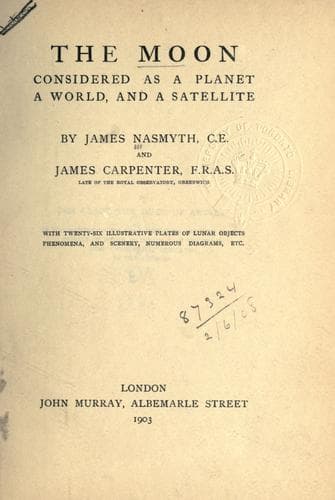
The Moon: considered as a planet, a world, and a satellite.Nasmyth, James
Science
The Moon: considered as a planet, a world, and a satellite.
Nasmyth, James
Moon
From our high standpoint, and looking backwards to the
sunny side of our cosmorama, we glance over a vast region of the wildest
volcanic desolation. Craters from five miles diameter downwards crowd
together in countless numbers, so that the surface, as far as the eye
can reach, looks veritably frothed over with them. Nearer the base of
the rampart on which we stand, extensive mountain chains run to north
and to south, casting long shadows towards us; and away to southward run
several great chasms a mile wide and of appalling blackness and depth.
Nearer still, almost beneath us, crag rises on crag and precipice upon
precipice, mingled with craters and yawning pits, towering pinnacles of
rock and piles of scoria and volcanic _débris_. But we behold no sign of
existing or vestige of past organic life. No heaths or mosses soften the
sharp edges and hard surfaces: no tints of cryptogamous or lichenous
vegetation give a complexion of life to the hard fire-worn countenance
of the scene. The whole landscape, as far as the eye can reach, is a
realization of a fearful dream of desolation and lifelessness—not a
dream of death, for that implies evidence of preexisting life, but a
vision of a world upon which the light of life has never dawned.
[Illustration: PLATE XXII.
ASPECT OF AN ECLIPSE OF THE SUN BY THE EARTH, AS IT WOULD APPEAR AS
SEEN FROM THE MOON.]
Looking again, after some hours’ interval, into the great crateral
amphitheatre, we see that the rays of the morning sun have crept down
the distant side of the rampart, opposite to that on which we stand, and
lighted up its vast landslipped terraces into a series of seeming
hill-circles with all the rude and rugged features of a terrestrial
mountain view, and none of the beauties save those of desolate grandeur.
The plateau of the crater is half in shadow 10,000 feet below, with its
grand group of cones, now fully in sight, rising from its centre.
Although these last are twenty miles away and the base of the opposite
rampart fully double that distance, we have no means of judging their
remoteness, for in the absence of an atmosphere there can be no aërial
perspective, and distant objects appear as brilliant and distinct as
those which are close to the observer. Not the brightness only, but the
various colours also of the distant objects are preserved in their full
intensity; for colour we may fairly assume there must be. Mineral
chlorates and sublimates will give vivid tints to certain parts of the
landscape surface, and there must be all the more sombre colours which
are common to mineral matters that have been subjected to fiery
influence. All these tints will shine and glow with their greater or
less intrinsic lustres, since they have not been deteriorated by
atmospheric agencies, and far and near they will appear clear alike,
since there is no aërial medium to veil them or tarnish their pristine
brightness.
Public-domain text, read in full here on John Shaqi.
Reviews
Reviews
No reviews yet
Be the first to share your thoughts on this work.
Elsewhere in the archive
Join the Discussion
Join the discussion
Sign in to leave a comment or review.
Sign InorCreate an account