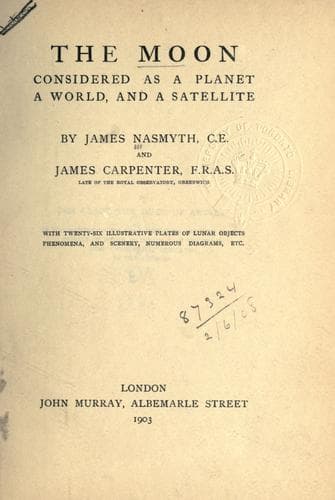
The Moon: considered as a planet, a world, and a satellite.Nasmyth, James
Science
The Moon: considered as a planet, a world, and a satellite.
Nasmyth, James
Moon
eclipse-observer would see the ring of light around the black
earth-globe brilliantly crimsoned; at other parts it would have other
shades of red and yellow, and the whole effect would be to make the
grand earth-ball, hanging in the lunar sky, like a dark sphere in a
circle of glittering gold and rubies.
During the early stages of the eclipse, this chaplet of
brilliant-coloured lights would be brightest upon the side of the
_disappearing_ sun; at the time of central eclipse the radiance
(supposing the sun to pass centrally behind the earth) would be equally
distributed, and during the later stages it would preponderate upon the
side of the _reappearing_ sun. We have endeavoured to give a pictorial
realization of this phenomenon and of the effect of the eclipse upon the
lunar landscape, but such a picture cannot but fall very, very far short
of the reality. (See Plate XXII.)
And now for a time let us turn attention from the lunar sky to the
scenery of the lunar landscape. Let us, in imagination, take our stand
high upon the eastern side of the rampart of one of the great craters.
Height, it must be remarked, is more essential on the moon to command
extent of view than upon the earth, for on account of the comparative
smallness of the lunar sphere the dip of the horizon is very rapid. Such
height, however, would be attained without great exercise of muscular
power, since equal amounts of climbing energy would, from the smallness
of lunar gravity, take a man six times as high on the moon as on the
earth. Let us choose, for instance, the hill-side of Copernicus. The day
begins by a sudden transition. The faint looming of objects under the
united illumination of the half-full earth and the zodiacal light is the
lunar precursor of day-break. Suddenly the highest mountain peaks
receive the direct rays of a portion of the sun’s disc as it emerges
from below the horizon. The brilliant lighting of these summits serves
but to increase, by contrast, the prevailing darkness, for they seem to
float like islands of light in a sea of gloom. At a rate of motion
twenty-eight times slower than we are accustomed to, the light tardily
creeps down the mountain-sides, and in the course of about twelve hours
the whole of the circular rampart of the great crater below us, and
towards the east, shines out in brilliant light, unsoftened by a trace
of mountain-mist. But on the opposite side, looking into the crater,
nothing but blackness is to be seen. As hour succeeds hour, the sunbeams
reach peak after peak of the circular rampart in slow succession, till
at length the circle is complete and the vast crater-rim, 50 miles in
diameter, glistens like a silver-margined abyss of darkness. By-and-by,
in the centre, appears a group of bright peaks or bosses. These are the
now illuminated summits of the central cones, and the development of the
great mountain cluster they form henceforth becomes an imposing feature
of the scene.
Public-domain text, read in full here on John Shaqi.
Reviews
Reviews
No reviews yet
Be the first to share your thoughts on this work.
Elsewhere in the archive
Join the Discussion
Join the discussion
Sign in to leave a comment or review.
Sign InorCreate an account