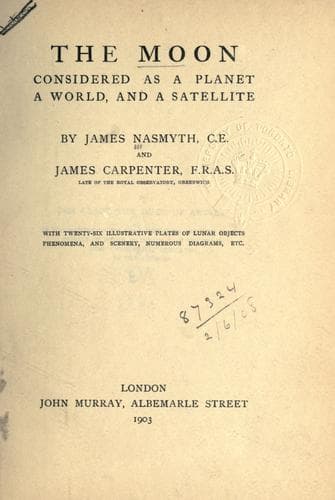
The Moon: considered as a planet, a world, and a satellite.Nasmyth, James
Science
The Moon: considered as a planet, a world, and a satellite.
Nasmyth, James
Moon
A legitimate extension of the imagination leads us to impressions of
lunar conditions upon other senses than that of sight, to which we have
hitherto confined our fancy. We are met at the outset with a difficulty
in this extension; for it is impossible to conceive the sensations which
the absence of an atmosphere would produce upon the most important of
our bodily functions. If we would attempt the task we must conjure up
feelings of suffocation, of which the thoughts are, however, too
horrible to be dwelt upon; we must therefore maintain the delusion that
we can exist without air, and attempt to realize some of the less
discomforting effects of the absence of this medium. Most notable among
these are the untempered heat of the direct solar rays, and the
influence thereof upon the surface material upon which we suppose
ourselves to stand. During a period of over three hundred hours the sun
pours down his beams with unmitigated ferocity upon a soil never
sheltered by a cloud or cooled by a shower, till that soil is heated, as
we have shown, to a temperature equal nearly to that of melting lead;
and this scorching influence is felt by everything upon which the sun
shines on the lunar globe. But while regions directly insolated are thus
heated, those parts turned from the sun would remain intensely cold, and
that scorching in sunshine and freezing in shade with which mountaineers
on the earth are familiar would be experienced in a terribly exaggerated
degree. Among the consequences, already alluded to, of the alternations
of temperature to which the moon’s crust is thus exposed, are doubtless
more or less considerable expansions and contractions of the surface
material, and we may conceive that a cracking and crumbling of the more
brittle constituents would ensue, together with a grating of contiguous
but disconnected masses, and an occasional dislocation of them. We refer
again to these phenomena to remark that if an atmospheric medium existed
they would be attended with noisy manifestations. There are abundant
causes for grating and crackling sounds, and such are the only sources
of noise upon the moon, where there is no life to raise a hum, no wind
to murmur, no ocean to boom and foam, and no brook to plash. Yet even
these crust-cracking commotions, though they might be felt by the
vibrations of the ground, would not manifest themselves audibly, for
without air there can be no communication between the grating or
cracking body and the nerves of hearing. Dead silence reigns on the
moon: a thousand cannons might be fired and a thousand drums beaten upon
that airless world, but no sound could come from them: lips might quiver
and tongues essay to speak, but no action of theirs could break the
utter silence of the lunar scene.
Public-domain text, read in full here on John Shaqi.
Reviews
Reviews
No reviews yet
Be the first to share your thoughts on this work.
Elsewhere in the archive
Join the Discussion
Join the discussion
Sign in to leave a comment or review.
Sign InorCreate an account