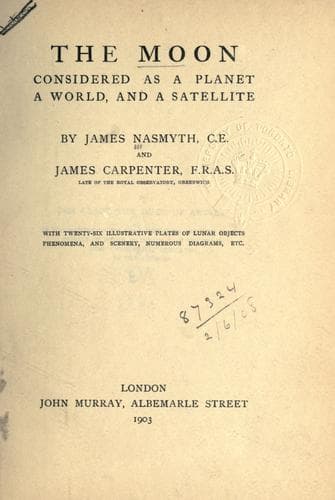
The Moon: considered as a planet, a world, and a satellite.Nasmyth, James
Science
The Moon: considered as a planet, a world, and a satellite.
Nasmyth, James
Moon
At a rate twenty-eight times slower than upon earth, the shadows shorten
till the sun attains his meridian height, and then, from the tropical
region upon which we have in imagination stood, nothing is to be seen on
any side, save towards the black sky, but dazzling light. The relief of
afternoon shadow comes but tardily, and the darkness drags its slow
length along the valleys and creeps sluggishly up the mountain-sides
till, in a hundred hours or more, the time of sunset approaches. This
phenomenon is but daybreak reversed, and is unaccompanied by any of the
gorgeous sky tints that make the kindred event so enrapturing on earth.
The sun declines towards the dark horizon without losing one jot of its
brilliancy, and darts the full intensity of its heat upon all it shines
on to the last. Its disc touches the horizon, and in half an hour dips
half-way beneath it, its intrinsic brightness and colour remaining
unchanged. The brief interval of twilight occurs, as in the morning,
when only a small chord of the disc is visible, and the long shadows now
sharpen as the area of light that casts them decreases. For a while the
zodiacal light vies with the earth-moon high in the heavens in
illuminating the scene; but in a few hours this solar appendage passes
out of view, and our world becomes the queen of the lunar night.
At this sunset time the earth, nearly in the zenith of us, will be at
its half-illuminated phase, and even then it will shed more light than
we receive upon the brightest of moonlight nights. As the night
proceeds, the earth-phase will increase through the gibbous stages until
at midnight it will be “full,” and our orb will be seen in its entire
beauty. It will perform at least one of its twenty-four-hourly rotations
during the time that it appears quite full, and the whole of its surface
features will in that time pass before the lunar spectator’s eye. At
times the northern pole will be turned towards our view, at times the
southern; and its polar ice-caps will appear as bright white spots,
marking its axis of rotation. If our lunar sojourn were prolonged we
should observe the northern ice-cap creep downwards to lower latitudes
(during our winter) and retreat again (during our summer); and this
variation would be perceptible in a less degree at the southern pole, on
account of the watery area surrounding it. The seas would appear (so far
as can be inferred) of pale blue-green tint; the continents
parti-coloured: and the tinted spots would vary with the changing
terrestrial seasons, as these are indicated by the positions and
magnitudes of the polar ice-caps. The permanent markings would be ever
undergoing apparent modification by the variations of the white
cloud-belts that encircle the terrestrial sphere. Of the nature of these
variations meteorological science is not as yet in a position to speak:
it would indeed be vastly to the benefit of that science if a view of
Public-domain text, read in full here on John Shaqi.
Reviews
Reviews
No reviews yet
Be the first to share your thoughts on this work.
Elsewhere in the archive
Join the Discussion
Join the discussion
Sign in to leave a comment or review.
Sign InorCreate an account