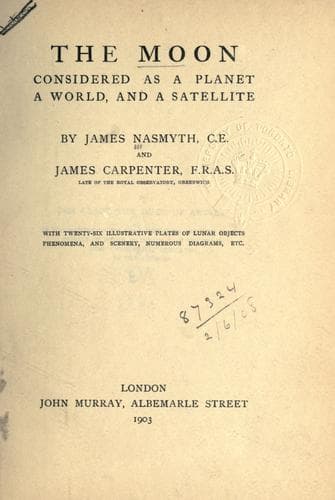
The Moon: considered as a planet, a world, and a satellite.Nasmyth, James
Science
The Moon: considered as a planet, a world, and a satellite.
Nasmyth, James
Moon
that man is more widely and immediately benefited by this purifying
office of the moon than by any other.
But the sanitary service is not the only one that the moon performs
through the agency of the tides. There is the work of tidal transport to
be considered. Upon tidal rivers and on certain coasts, notwithstanding
wind and the use of steam, a very large proportion of the heavy
merchandize is transported by that slow but powerful “tug” the
flood-tide; and a similar service, for which, however, the moon is not
to be entirely credited, is done by the down-flow of the ebb-tide. Large
ships and heavily-laden rafts and barges are quietly taken in tow by
this unobtrusive prime mover, and moved from the river’s mouth to the
far-up city, and from wharf to wharf along its banks; and a vast amount
of mechanical work is thus gratuitously performed which, if it had to be
provided by artificial means, would represent an amount of money value
which for such a city as London would have to be counted by thousands,
possibly millions, of pounds yearly. For this service we owe the moon
the gratitude that we ought to feel for a direct pecuniary benefactor.
In the existing state of civilization and prosperity, we do not,
however, utilize the power of the tides nearly to the extent of their
capabilities. Our coal mines, rich with “the light of other days”—for
coal was long ago declared by Stevenson to be “bottled sunshine”—at
present furnish us with so abundant a supply of power-generating
material that in our eagerness to use it upon all possible occasions we
are losing sight, or putting out of mind, many other valuable prime
movers, and amongst them that of the rise and fall of the waters, which
can be immediately converted into any form of mechanical power by the
aid of tide-mills. Such mills may be found in existence here and there,
but for the present they are generally out-rivalled by the steam-engine
with all its conveniences and adaptabilities; and hence they have not
shared the benefits of that inventive ingenuity which has achieved such
wonders of mechanical appliance while steam has been in the ascendant.
But it must be remembered that in our extravagant use of coal we are
drawing from a bank into which nothing is being paid. We are consuming
an exhaustive store, and the time must come when it will be needful to
look around in quest of “powers that may be.” Then an impetus may be
given to the application of the tides to mechanical purposes as a prime
mover.[19] For the people of the British Islands the problem would have
an especial importance, viewing the extent of our seaboard and the
number of our tidal rivers. The source of motion that offers itself is
of almost incalculable extent. There is not merely the onward flowing
motion of streams to be utilized, but also the _lift_ of water, which,
if small in extent, is stupendous in amount; and within certain limits
it matters little to the mechanician whether the “foot-pounds” of work
Public-domain text, read in full here on John Shaqi.
Reviews
Reviews
No reviews yet
Be the first to share your thoughts on this work.
Elsewhere in the archive
Join the Discussion
Join the discussion
Sign in to leave a comment or review.
Sign InorCreate an account