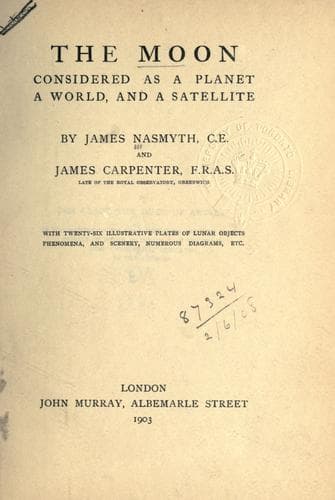
The Moon: considered as a planet, a world, and a satellite.Nasmyth, James
Science
The Moon: considered as a planet, a world, and a satellite.
Nasmyth, James
Moon
The most generally appreciated because the most evident of the uses of
the moon is that of a luminary. Popular regard for it is usually
confined to its service in that character, and in that character poets
and painters have never tired in their efforts to glorify it. And
obviously this service as a “lesser light” is sufficiently prominent to
excite our warmest admiration. But moonlight is, from the very
conditions of its production, of such a changeable and fugitive nature,
and it affords after all so partial and imperfect an alleviation of
night’s darkness, that we are fain to regard the light-giving office of
the moon as one of secondary importance. Far more valuable to mankind in
general, so estimable as to lead us to place it foremost in our category
of lunar offices, is the duty which the moon performs in the character
of a sanitary agent. We can conceive no direful consequences that would
follow from a withdrawal of the moon’s mere light; but it is easy to
imagine what highly dangerous results would ensue if the moon ceased to
produce the tides of the ocean. Motion and activity in the elements of
the terraqueous globe appear to be among the prime conditions in
creation. Rest and stagnation are fraught with mischief. While the sun
keeps the atmosphere in constant and healthy circulation through the
agency of the winds, the moon performs an analogous service to the
waters of the sea and the rivers that flow into them. It is as the chief
producer of the tides—for we must not forget that the sun exercises
_its_ tidal influences, though in much lesser degree—that we ought to
place the highest value on the services of the moon: but for its aid as
a mighty scavenger, our shores, where rivers terminate, would become
stagnant deltas of fatal corruption. Twice (to speak generally) a day,
however, the organic matter which rivers deposit in a decomposing state
at their embouchures is swept away by the tidal wave; and thus, thanks
to the moon, a source of direful pestilence is prevented from arising.
Rivers themselves are providentially cleansed by the same means, where
they are polluted by bordering towns and cities which, from the nature
of things, are sure to arise on river banks; and it seems to be also in
the nature of things that the river traversing a city must become its
main sewer. The foul additions may be carried down by the stream in its
natural course towards the ocean, but where the river is large there
will be a decrease in velocity of the current near the mouth or where it
joins the sea, thus causing partial stagnation and consequent deposition
of the deleterient matters. All this, however, is removed, and its
inconceivable evils are averted by our mighty and ever active “sanitary
commissioner,” the moon. We can scarcely doubt that a healthy influence
of less obvious degree is exerted in the wide ocean itself; but,
considering merely human interests, we cannot suppress the conviction
Public-domain text, read in full here on John Shaqi.
Reviews
Reviews
No reviews yet
Be the first to share your thoughts on this work.
Elsewhere in the archive
Join the Discussion
Join the discussion
Sign in to leave a comment or review.
Sign InorCreate an account